

Best Leather Journals: How to Choose by Leather, Paper and Binding
Ten covers ranked on published insert dimensions, maximum spine thickness and whether the maker names a single notebook it has actually been tested against. Leather grade came last.
By [BRAND] Editorial · Updated 25 August 2026 · Prices checked 25 August 2026 · ~4,800 words · 19 min read
|
HOW THIS GUIDE IS FUNDED BRAND_NAME makes leather journal covers. None of the ten picks below are ours. We kept this list to other makers so the fit criteria stand on their own, and we will add our own cover to it only when it publishes the same numbers we are demanding here. No brand paid for placement. We name competitor products but do not link to them.
|
Our Picks at a Glance
|
BEST OVERALL REFILLABLE
 TRAVELER'S notebook Starter Kit, Regular
$60
|
BEST ON A BUDGET
 Galen Leather Slim B6 Cover
$47
|
BEST FIT PRECISION
 Popov Leather A5 Notebook Cover
Price on request
|
Every pick in this guide, ranked by how precisely the maker tells you what will fit inside it.
|
Pick
|
Retention system
|
Published fit
|
Closed size
|
Price
|
|
TRAVELER'S notebook, Regular
|
Elastic bands over the spine
|
House format. Insert count not capped
|
Approx. 216 x 114 mm
|
$60
|
|
TRAVELER'S notebook, Passport
|
Elastic bands over the spine
|
House format. Not published
|
Not published
|
$48
|
|
Paper Republic grand voyageur [xl]
|
Ribbon system
|
Books up to 140 x 200 mm
|
145 x 210 mm
|
Not published
|
|
Galen Leather Refillable Wrap Cover
|
Wrap, refillable
|
Not published
|
Not published
|
$49
|
|
Galen Leather Slim A5 Cover
|
Slip pockets
|
Nine named softcover A5 notebooks
|
160 x 220 mm
|
$54
|
|
Galen Leather Slim B6 Cover
|
Slip pockets
|
B6. Standard not specified
|
Not published
|
$47
|
|
Popov Leather A5 Notebook Cover
|
Slip pockets, pen-loop closure
|
Books up to 210 x 150 x 17.5 mm
|
Not published
|
Not published
|
|
Galen Leather Leuchtturm1917 A5 Cover
|
Slip pockets plus storage
|
Leuchtturm1917 A5 hardcover, iPad Mini
|
170 x 230 mm
|
$69
|
|
Galen Leather Zippered A5 Folio
|
Zip shell
|
Leuchtturm1917 A5 hardcover
|
Not published
|
$129
|
|
Galen Leather Zippered B6 Folio
|
Zip shell
|
B6 or B6 slim planner
|
Not published
|
$94
|
Two picks do not publish a price, and both cards say so instead of carrying an estimate. Five do not publish a closed dimension. Only one publishes a maximum spine thickness, which is the single most useful number in this entire table and the reason it wins the fit award.
Which Leather Journal Wins for Your Notebook?
For most people the TRAVELER'S notebook Starter Kit, Regular ($60) is the right buy, because it arrives with a cover, an insert, a spare band and a bag, and the elastic system takes almost anything cut near 210 mm tall. On a tight budget the Galen Leather Slim B6 Cover ($47) is the cheapest vegetable-tanned full-grain cover here. If a thick hardback has already defeated one cover, the Popov Leather A5 Notebook Cover publishes a maximum book size of 210 x 150 x 17.5 mm and backs it with a lifetime guarantee, though you will have to ask for the price.
Damage to a journal in a bag is rarely dramatic. It is a cover cut 3 mm too wide, so the book slid inside it for a month and the spine now opens crooked.
The fit is the problem. Not the hide, not the stitching, not the price. Most covers publish a size name and nothing else, and a size name is not a measurement, because ISO B6 at 125 x 176 mm and JIS B6 at 128 x 182 mm both get sold as "B6" and a sleeve cut for one will not take the other.
Capacity is the usual first fork in a journal guide. Here it is the second. Retention system comes first, and the ten picks below are grouped by it.
Pick by need
|
You have
|
Buy this
|
Why
|
|
No notebook yet
|
A complete elastic starter kit
|
Cover, insert and spare band arrive together
|
|
Two or three subjects at once
|
Elastic or ribbon
|
Separate inserts, one cover
|
|
One softcover you already love
|
A slim sleeve cut for it
|
No elastic runs through your pages
|
|
A hardback over 15 mm thick
|
A cover publishing a maximum thickness
|
|
|
A bag with keys and a charger in it
|
Zip folio
|
The fore edge is the first thing to crush
|
|
A planner opened twenty times a day
|
Compact zip folio
|
Protection without A5 bulk
|
|
A finished volume to shelve
|
A bound journal, not a cover
|
Nothing in this list is designed to be archived full
|
How We Judged These Covers
Fit first. This is a desk-researched comparison built on manufacturer-published dimensions, fit lists and hide descriptions, with prices checked on 25 August 2026. Where a maker does not publish a figure, the card says "Not published" rather than guessing at one.
Fit range. The largest notebook the interior genuinely accepts, in millimetres. A published maximum thickness scored highest. A named list of tested notebooks scored next. A size label on its own scored nothing.
Material transparency. Whether the seller names the hide, the grade and the tanning method in the specification rather than the headline. Naming the tannery scored highest of all.
Refill logistics. Whether replacement inserts are a common size or a house format, and whether bands and ribbons are sold separately when they perish.
Everyday use. Loading speed, whether the cover stays shut in a bag, and how it behaves once pockets and inserts have added bulk.
Every card carries an evidence line naming manufacturer specifications or an authorized dealer listing. Marketing adjectives on their own settle nothing.
What Counts as a Fit Problem
Trouble starts above about 15 mm of spine thickness. Below that, most covers behave.
People quote the size of their notebook. A cover cares about a different set of numbers, the height, the width and the spine depth with the covers closed, and the third one is what almost nobody measures. Two people both using "an A5 notebook". Two completely different books.
|
Spine thickness
|
Inches
|
Category
|
Cover implication
|
|
Under 8 mm
|
Under 0.3 in
|
Thin
|
Slides inside sleeve pockets. Elastic or ribbon holds it better
|
|
9 to 14 mm
|
0.35 to 0.55 in
|
Standard
|
Most sleeve covers accept this without complaint
|
|
15 to 17.5 mm
|
0.6 to 0.7 in
|
Thick
|
Only covers publishing a maximum will take it reliably
|
|
18 mm and up
|
0.7 in and up
|
Very thick
|
Sleeve pockets will not close. Elastic, wrap or folio only
|
A Leuchtturm1917 A5 hardback sits in the third band. A Field Notes book sits in the first. A traveler-style insert sits in the first as well, which is exactly why elastic systems can carry three of them at once.
Why the Wrong Cover Damages a Journal
Four failure modes. All of them mechanical.
Spine splay. A cover cut too wide lets the book slide side to side every time the bag moves. The block works loose from the case over weeks, and a sewn journal that used to open flat starts opening crooked. Nothing re-tightens it.
Elastic scoring. A band running over the spine of an insert presses a permanent groove into the fold within a month. On a leather cover the same band leaves a matching line where it sits, which is fine as patina and less fine as a crease that cracks.
Corner crush. The fore edge is the first casualty in a packed bag, because sleeve covers leave it exposed by design. Once the corners of the block go soft they stay soft.
Closure strain. A snap set for an empty cover cannot reach once two inserts, a pen and a stack of receipts are inside. The hardware pulls at its anchor stitching, and that stitching is usually the weakest seam on the whole object.
|
WATCH OUT
Do not fix a loose cover by folding paper into the pocket behind the notebook. That adds thickness in the wrong place and forces the front cover to sit proud, which is how the closure anchor tears. Too large means a smaller cover or a thicker insert. Not shims.
|
Best Elastic and Ribbon Systems
Elastic and ribbon systems hold one or more separate notebooks against the inside spine, which is the only mechanism that lets one cover carry three subjects at once. These four are the picks where the cover outlives the paper by the widest margin. One arrives ready to write, one is the thinnest thing here, and one is the cheapest vegetable-tanned cover in the guide.
BEST OVERALL REFILLABLE
1. TRAVELER'S COMPANY TRAVELER'S notebook Starter Kit, Regular Size

The reference point for the whole category, and the only pick here that arrives with paper in it. The elastic runs over the insert spine rather than through your pages, and the refill catalogue behind it is the deepest in the market.
|
Exterior
|
Cow leather, hand made in Chiang Mai, Thailand, naturally dyed without heavy surface treatment
|
|
Lining
|
None. Unlined hide, inside and out
|
|
Retention system
|
Elastic bands over the spine, tin clasp
|
|
Closed size
|
Approximately 216 x 114 mm, taller and narrower than A5
|
|
In the box
|
Cover, blank MD paper refill, spare connecting band, cotton storage bag
|
|
Paper
|
MD paper made in Japan, described by the maker as bleed and feather resistant
|
|
Fit
|
House format. More inserts via additional connecting bands
|
|
Pen loop
|
Not published. A brass clip is sold separately
|
|
Leather thickness
|
Not published
|
WHAT WORKS
✓ Arrives ready to write, which no other pick in this guide does
✓ Refill range runs from watercolor paper to dated planners
✓ Bands are treated as a consumable and a repair kit is sold
✓ Naturally dyed hide marks and darkens fast, which is the point of buying it
WHAT TO WEIGH
– House size, not ISO. Third-party inserts have to be cut for it
– No pen loop in the box
– Both sizes were listed out of stock at the dealer we checked
– Leather thickness is not published, so judge stiffness from photos
Best for: A first refillable system, and anyone who wants one purchase to end the decision.
$60.00 Price checked 25 August 2026 Check price at TRAVELER'S COMPANY
Evidence: Manufacturer product description and authorized dealer listing, both read 25 August 2026. Paper performance claims are the manufacturer's own.
BEST POCKET CARRY
2. TRAVELER'S COMPANY TRAVELER'S notebook Starter Kit, Passport Size

The same system shrunk to jacket-pocket scale for twelve dollars less. It shares the band and clip accessories with the Regular, so nothing you buy for one is wasted on the other.
|
Exterior
|
Cow leather, hand made in Thailand
|
|
Lining
|
None
|
|
Retention system
|
Elastic bands over the spine
|
|
Closed size
|
Not published in the listings we checked
|
|
In the box
|
Cover, blank refill, spare band, storage bag
|
|
Paper
|
Designphil original paper, made in Japan
|
|
Fit
|
House passport format
|
|
Pen loop
|
Not published
|
|
Leather thickness
|
Not published
|
WHAT WORKS
✓ Small enough that it actually leaves the house every day
✓ Shares brass clips and bands with the Regular size
✓ Cheapest route into the ecosystem at $48.00
✓ Same hide and the same aging behavior as the larger cover
WHAT TO WEIGH
– Narrow format, so long lines of handwriting feel cramped
– Closed dimensions are not published, so measure against a dealer photo
– Fewer refill rulings than the Regular
– Also listed out of stock at the dealer we checked
Best for: Lists, travel notes and quick capture rather than long-form journaling.
$48.00 Price checked 25 August 2026 Check price at TRAVELER'S COMPANY
Evidence: Authorized dealer listing and manufacturer product page, read 25 August 2026.
BEST PUBLISHED INSERT FIT
3. Paper Republic grand voyageur [xl]

Vienna-made, raw-edged, and the only pick in this group that prints the maximum notebook it accepts. That single line answers the question most buyers never get to ask.
|
Exterior
|
Vegetable-tanned leather, described by the maker as full grain, Italian
|
|
Lining
|
Unlined
|
|
Retention system
|
Ribbon system
|
|
Closed size
|
145 x 210 mm
|
|
Fit
|
Books up to 140 x 200 mm
|
|
Insert capacity
|
Maker page says up to 3 refills. A retail product listing says 2 with the ribbons supplied, with a third needing an extra ribbon set. Both readings are printed here
|
|
Paper
|
Refills from European mills, acid-free, FSC and PEFC certified per the maker
|
|
Extras
|
Holds a passport and a pen
|
|
Price
|
Not published in our check on 25 August 2026
|
WHAT WORKS
✓ Publishes a maximum insert size in millimetres, which almost nobody in this category does
✓ Slimmest body of any multi-insert pick here
✓ Raw-cut edges age visibly rather than cracking at a painted edge
✓ Refill range spans 80 to 300 gsm
WHAT TO WEIGH
– Capacity claim disagrees between the maker page and a retail listing. Assume two refills unless you buy extra ribbons
– No price rendered on our check date
– Ribbons are a proprietary accessory
– A true 148 mm wide A5 insert will not fit inside the 140 mm limit
Best for: A traveler carrying two subjects and a passport in one slim object.
Not published Price checked 25 August 2026 Check price at Paper Republic
Evidence: Manufacturer product page and size guide, plus a retail listing stating a different refill capacity. Both readings are printed above rather than reconciled.
BEST WRAP CLOSURE
4. Galen Leather Refillable Leather Wrap Journal / Planner Cover

The cheapest way into vegetable-tanned refillable carry. A wrap closure adjusts as the cover fattens, which a fixed snap cannot, and that matters more than it sounds once a year of receipts is inside.
|
Exterior
|
Vegetable-tanned cow leather, crazy horse finish
|
|
Lining
|
Unlined
|
|
Retention system
|
Refillable, leather wrap closure
|
|
Closed size
|
Not published for this model
|
|
Fit
|
Not published
|
|
Insert capacity
|
Refillable. Count not published
|
|
Made in
|
Turkey, hand stitched
|
|
Leather thickness
|
Not published
|
WHAT WORKS
✓ Wrap closures keep working as bulk grows
✓ Crazy horse finish lightens where it scuffs, then blends back in
✓ Lowest price of any vegetable-tanned refillable cover here
✓ Same tannery and stitching as the maker's more expensive covers
WHAT TO WEIGH
– No published dimensions at all, which is unusual for this maker
– Wrap ties take a few seconds longer than an elastic, every single time
– No stated insert count, so plan for one book
– Colorway availability moves week to week
Best for: A first vegetable-tanned cover when the budget stops short of sixty dollars.
$49.00 Price checked 25 August 2026 Check price at Galen Leather
Evidence: Manufacturer collection listing read 25 August 2026. Model-level dimensions were absent and are marked not published.
|
VERDICT The TRAVELER'S Regular wins this group because it is complete in the box and the refill ecosystem behind it has no rival. Take the grand voyageur if slimness matters more than capacity, budget for the extra ribbon set, and note the 140 mm width ceiling before assuming an A5 insert will fit. The Passport is the same system for a smaller pocket. The Galen wrap cover is the value play and the only one here under fifty dollars, but you are buying with no published dimensions at all, so measure your notebook and be ready to return it.
|
Best Sleeve Covers, Where the Notebook Does the Work
There is a second way to solve the problem. Let the notebook's own covers slide into leather pockets and no elastic ever touches your pages. The writing surface stays completely clear. The tradeoff is tolerance, because a sleeve is cut for one size and will not stretch to meet you.
BEST FIT DISCLOSURE
5. Galen Leather Slim A5 Notebook / Planner Cover

Nine notebooks named by the maker, by brand and model. That list removes almost all of the guesswork this article exists to solve, and it is the reason this cover outranks more expensive ones.
|
Exterior
|
100 percent vegetable-tanned cow leather, full grain
|
|
Lining
|
Unlined leather
|
|
Retention system
|
Slip pockets on both inner covers
|
|
Closed size
|
160 x 220 mm
|
|
Fit
|
Midori MD A5, Hobonichi Cousin A5, Stalogy 365, Life A5, Apica CD A5, Logical Prime A5, Kleid A5, Yamamoto A5, Nanami A5, plus the maker's own A5 books. All softcover A5 generally
|
|
Stitching
|
Hand stitched with waxed polyamide thread
|
|
Storage
|
Card and bookmark slots on the inner covers
|
|
Pen loop
|
Yes
|
|
Included
|
Cover only. No notebook
|
WHAT WORKS
✓ Nine tested notebooks published by brand and model
✓ Crazy horse and undyed finishes both age fast and visibly
✓ Pen loop and card slots without folio bulk
✓ Same $54.00 across every colorway we checked, so no premium on the popular ones
WHAT TO WEIGH
– Softcover only. A Leuchtturm1917 hardback needs the wider cover instead
– No closure, so it can open inside a crammed bag
– Cover only, so budget roughly another $32.00 for a first insert
– Maximum spine thickness is not published, only the fit list
Best for: Anyone already loyal to a softcover A5 notebook brand.
$54.00 Price checked 25 August 2026 Check price at Galen Leather
Evidence: Manufacturer product and collection pages read 25 August 2026, including the published fit list and the 16 x 22 cm closed dimension.
BEST ON A BUDGET
6. Galen Leather Slim B6 Notebook / Planner Cover

The A5 build shrunk to a size that suits one hand, seven dollars cheaper. B6 is the quiet sweet spot between a pocket book and a usable line length, and this is the cheapest full-grain cover in the guide.
|
Exterior
|
Vegetable-tanned cow leather, full grain
|
|
Lining
|
Unlined leather
|
|
Retention system
|
Slip pockets
|
|
Closed size
|
Not published for the B6 model
|
|
Fit
|
B6. The maker does not state whether this is ISO B6 at 125 x 176 mm or JIS B6 at 128 x 182 mm
|
|
Stitching
|
Hand stitched
|
|
Storage
|
Card and bookmark slots
|
|
Pen loop
|
Yes
|
|
Included
|
Cover only
|
WHAT WORKS
✓ Cheapest full-grain vegetable-tanned cover in this comparison
✓ B6 fits a coat pocket in a way A5 never will
✓ Same construction and stitching as the A5 model
✓ Undyed option available if you want to watch the patina from day one
WHAT TO WEIGH
– The B6 label is ambiguous across markets and the maker does not resolve it
– Closed dimensions are not published for this model
– No closure
– Fewer named compatible notebooks than the A5 version
Best for: Commuters who find A5 slightly too big for one hand.
$47.00 Price checked 25 August 2026 Check price at Galen Leather
Evidence: Manufacturer collection listing read 25 August 2026. ISO B6 dimension from ISO 216.
BEST FIT PRECISION
7. Popov Leather A5 Notebook Cover

The only pick in this guide that publishes a maximum spine thickness, and the only one that names the tannery its hide comes from. If a thick hardback has already defeated a cover, this is the card to read twice.
|
Exterior
|
Full-grain leather from Seidel Tanning, Milwaukee, Wisconsin
|
|
Lining
|
Unlined leather
|
|
Retention system
|
Slip pockets, closed by a pen through two interlocking loops
|
|
Closed size
|
Not published
|
|
Fit
|
Books up to 210 mm high x 150 mm wide x 17.5 mm thick
|
|
Tested against
|
Leuchtturm1917 A5, Hobonichi Techo Cousin, Rhodiarama hardcover, Clairefontaine A5, the maker's own A5
|
|
Stitching
|
Hand saddle stitch using Ritza 25 Tiger thread
|
|
Made in
|
Nelson, British Columbia, Canada
|
|
Warranty
|
Guaranteed for life
|
WHAT WORKS
✓ A published maximum thickness of 17.5 mm, which nothing else here offers
✓ The only pick naming the tannery behind its hide
✓ Interlocking pen loops double as the closure
✓ Lifetime guarantee on the stitching and the leather
WHAT TO WEIGH
– No price rendered on the pages we checked
– Undyed full-grain shows every mark, by design
– Sized for hardcovers, so a floppy softcover will move inside it
– Engraved goods are usually harder to return
Best for: A thick hardback, and buyers who want construction detail on the record before paying.
Not published Price checked 25 August 2026 Check price at Popov Leather
Evidence: Manufacturer product and collection pages read 25 August 2026, including the 21 x 15 x 1.75 cm maximum book size, the Seidel tannery reference and the lifetime guarantee.
BEST FOR HARDCOVER BOOKS
8. Galen Leather Leuchtturm1917 A5 Notebook Cover

Cut wider than a softcover sleeve and given three usable pockets instead of a single slot. It works as a light folio without carrying a zip, and it takes an iPad Mini, which almost no journal cover manages.
|
Exterior
|
Vegetable-tanned cow leather
|
|
Lining
|
Unlined leather
|
|
Retention system
|
Slip pockets plus interior sleeves
|
|
Closed size
|
170 x 230 mm
|
|
Fit
|
Leuchtturm1917 A5 hardcover. Also takes an iPad Mini per the maker
|
|
Storage
|
One phone pocket, two card holders, sleeves under the pockets on both sides
|
|
Extra capacity
|
Left side takes a Field Notes book, a passport or a phone
|
|
Pen loop
|
Not published
|
|
Included
|
Cover only
|
WHAT WORKS
✓ Genuinely sized for a hardback rather than a softcover pretending to be one
✓ Three pockets make it a light folio without zip weight
✓ Doubles as an iPad Mini sleeve
✓ Ten millimetres of extra width over the slim A5 buys real storage
WHAT TO WEIGH
– At 170 x 230 mm it is the bulkiest non-zip cover here
– Pen loop is not stated on the listing
– Pockets fill fast and then the cover stops sitting flat
– Fifteen dollars more than the slim A5 for the same hide
Best for: Leuchtturm1917 and hardback users who want cards and a phone in the same object.
$69.00 Price checked 25 August 2026 Check price at Galen Leather
Evidence: Manufacturer product page read 25 August 2026, including the 17 x 23 cm closed dimension and the pocket layout.
|
VERDICT The Slim A5 is the pick for most people in this group, because a published nine-notebook fit list is worth more than any amount of description. Move up to the Leuchtturm1917 cover only if your notebook is a hardback or you want the pockets. Popov wins the fit award outright on its 17.5 mm ceiling and its lifetime guarantee, and it is the one to buy for a thick book, though you will have to ask for the price. B6 buyers should settle which B6 standard their notebook uses before ordering anything at all.
|
Best Zip Folios, Where Protection Beats Access
The last approach closes the object on all four sides. You give up quick access and gain the only real crush resistance in this guide. Both picks come from the same maker and neither publishes a closed dimension, which is the weak point of the whole category.
BEST PROTECTION
9. Galen Leather Zippered A5 Leuchtturm1917 Notebook Folio

The pick for a bag that also carries keys, a charger and a water bottle. A zip is the only thing in this comparison that covers the fore edge, and the fore edge is where notebook damage starts.
|
Exterior
|
Vegetable-tanned cow leather, crazy horse finish
|
|
Lining
|
Leather interior with fitted pockets
|
|
Retention system
|
Full zip shell
|
|
Closed size
|
Not published
|
|
Fit
|
Leuchtturm1917 A5 hardcover notebook
|
|
Storage
|
Pen storage plus card and document slots
|
|
Included
|
Cover only
|
|
Related model
|
A wide A5 zip folio is offered by the same maker at $149.00
|
WHAT WORKS
✓ Nothing falls out and no corner is left exposed
✓ Pen and papers travel with the notebook instead of loose in the bag
✓ Crazy horse hide takes bag abrasion and looks better for it
✓ The zip line protects page edges, which is where most damage begins
WHAT TO WEIGH
– At $129.00 it costs more than double the slim A5 cover
– Zips add weight and one more component that can fail
– Closed dimensions are not published, so bag fit is a guess until it arrives
– Slower to open than anything else in this guide
Best for: Commuters, site work, and anyone who has already ruined a notebook corner.
$129.00 Price checked 25 August 2026 Check price at Galen Leather
Evidence: Manufacturer collection listing read 25 August 2026. Closed dimensions were not stated and are marked not published.
BEST COMPACT FOLIO
10. Galen Leather Zippered B6 / B6 Slim Planner Folio

The same zip protection in a body that still fits a jacket pocket, thirty-five dollars cheaper. Sized for planners specifically, including the slim format that most covers ignore entirely.
|
Exterior
|
Vegetable-tanned cow leather, crazy horse finish
|
|
Lining
|
Leather interior
|
|
Retention system
|
Full zip shell
|
|
Closed size
|
Not published
|
|
Fit
|
B6 or B6 slim planner
|
|
Storage
|
Pen and card storage
|
|
Included
|
Cover only
|
WHAT WORKS
✓ Thirty-five dollars less than the A5 folio for the same construction
✓ B6 slim compatibility, which very few covers state
✓ Small enough that the zip weight stops mattering
✓ Protects a planner that gets opened twenty times a day
WHAT TO WEIGH
– Still nearly double the price of a plain B6 sleeve
– B6 slim and standard B6 are different books. Check which you own
– Closed dimensions not published
– A planner grown fat on sticky notes will strain the zip line
Best for: Planner users who want protection without carrying an A5 folio.
$94.00 Price checked 25 August 2026 Check price at Galen Leather
Evidence: Manufacturer collection listing read 25 August 2026.
|
VERDICT Both folios do the same job at two scales, and neither publishes a closed dimension, which is why neither takes an overall award. Buy the A5 folio if your notebook is a hardback and your bag is rough. Buy the B6 folio if you carry a planner and open it constantly. If your commute is a laptop sleeve and a train, a sleeve cover from the previous group does enough and saves seventy-five dollars.
|
Fit Check: The Two Minutes That Prevent a Return

Fit is the weakest part of almost every leather journal guide online. A cover can use excellent hide and still be the wrong purchase because it was cut 3 mm narrow. Measure your own notebook first.
-
Close the notebook the way it sits in your bag. Elastic fastened, ribbon inside, no flattening it for the test.
-
Lay it flat and measure height and width in millimetres, cover edge to cover edge rather than page edge to page edge.
-
Stand it on its spine and measure the depth across the closed block. This is the number nobody takes and the one that decides everything.
-
If you plan to carry two inserts, add both depths together, then add 2 mm for the elastic sitting between them.
-
Compare all three numbers against the cover's internal figures, not its external ones. A cover listed at 160 x 220 mm is describing its own outside.
-
Add roughly 3 to 5 mm of slack for a sleeve cover. Elastic, ribbon and wrap systems are far more forgiving.
-
Load it, close it, then hold it by the spine and shake gently. Movement you can hear means the cover is wrong for that book.
|
Measure
|
Take it from
|
Compare against
|
|
Height
|
The tallest notebook you plan to carry
|
Published internal height, or the fit list
|
|
Width
|
The same notebook, cover edge to cover edge
|
Published internal width
|
|
Spine depth
|
The closed block, standing on its spine
|
Published maximum thickness. Only one pick here states one
|
|
Combined depth
|
All inserts stacked, plus 2 mm per elastic
|
Whether the closure still reaches
|
|
Pocket depth
|
Not applicable
|
How much of your page width the slip pocket eats
|
|
TIP
Keep the three numbers in a note on your phone. Ours read 148 x 210 x 16 mm, off a Leuchtturm1917 hardback. That third figure has ruled out more covers than the other two combined, and it is the first thing we publish on our A5 refillable covers.
|
|
|
Protection Features That Matter More Than Leather Grade
Leather decides how the cover looks in year five. Structure decides what happens when a laptop and a water bottle share a bag with it. Different questions.
|
Feature
|
What it actually does
|
What to check
|
|
Retention type
|
Holds the book without deforming its spine
|
Elastic and ribbon for multiple inserts, sleeves for one
|
|
Fore edge coverage
|
Stops the corners crushing
|
Only a zip folio covers it fully
|
|
Closure reach
|
Keeps the cover shut once bulk is added
|
Test loaded, never empty
|
|
Stitch placement
|
Keeps hard seams away from the page block
|
Look at the spine fold and the closure anchor
|
|
Edge finish
|
Predicts where the cover fails first
|
Raw edges age. Painted edges crack
|
|
Lining bond
|
Stops the interior separating from the shell
|
Feel the pocket corners for lifting
|
Edge finish is the spec that separates a cover that ages from one that degrades. A raw-cut edge, like the one on the grand voyageur, darkens and rounds over. A painted edge looks sharper in year one, then cracks along the fold line where the cover bends most, and there is no repair once it starts.
Which Materials Travel Best
"Leather" is a regulated word on a product page. The FTC Leather Guides treat it as deceptive to use the unqualified word leather when a product is not wholly leather, and they call for disclosure of material that appears to be leather but is not. If a listing says leather with no qualifier and the price looks impossible, read the material line again.
Grade is checkable too. The Leather Working Group defines full grain as leather that has kept its entire grain, with none of the surface removed by corrective mechanical treatment, and corrected grain as leather whose grain has been partially buffed away. The same definitions library sets a limit worth memorising: for a material to be called leather at all, any surface coating must be no thicker than 0.15 mm. Above that you are buying a coating that happens to sit on hide.
Vegetable tanning is a method rather than a grade, and it is what nine of the ten picks here use. It is why they darken visibly with light and handling. Crazy horse is a waxed pull-up finish over that hide, and it lightens where it stretches, then blends back, which is why it hides travel scuffs better than a smooth surface. A brand that names its tannery, as Popov does, is telling you something. So is a brand that names nothing.
What You Should Expect to Pay
|
Tier
|
Typical price
|
What you get
|
Watch out for
|
|
Entry
|
Under $50
|
Vegetable-tanned hide, refillable, hand stitching
|
Dimensions often unpublished
|
|
Mid
|
$50 to $70
|
Published fit lists, pen loops, card slots, complete starter kits
|
Cover only. Budget for an insert
|
|
Upper mid
|
$90 to $130
|
Zip protection and interior storage
|
Paying for hardware, not for fit
|
|
Price on request
|
Not listed
|
Named tannery, lifetime guarantee, bespoke sizing
|
You cannot compare until you ask
|
A $129 folio does not automatically fit better than a $47 sleeve. In this guide the pick with the most precise published fit does not list a price at all, and the $54 cover names nine notebooks while the $129 one names one. Measurements decide fit. Price decides finish. Add roughly $32 for a first A5 insert on any cover-only pick, and read our leather journal covers built for A5 notebooks the same way you read these.
Cover vs Bound Journal vs Folio
|
|
Refillable cover
|
Zip folio
|
Bound journal
|
|
Paper replaceable
|
Yes
|
Yes
|
No
|
|
Multiple subjects
|
Elastic and ribbon only
|
Rarely
|
No
|
|
Fore edge protection
|
None
|
Full
|
Partial
|
|
Packed size
|
Smallest
|
Largest
|
Fixed
|
|
Opens flat
|
Usually
|
Yes
|
Depends on binding
|
|
Entry price here
|
$47
|
$94
|
Not covered in this guide
|
|
Best for
|
Years of use from one cover
|
Rough bags
|
Archiving a finished volume
|
Bound journals are deliberately absent from the picks. Once the pages are full the leather is full too, and every pick above earned its place because the cover outlives the paper.
How to Choose in Seven Steps
-
Pick the paper first. Ruling, weight, and whether your pen is happy on it. Everything downstream depends on this.
-
Measure that notebook. Height, width, spine depth. Write all three down.
-
Filter to covers that publish a fit list or a maximum thickness. Silence is an answer.
-
Choose the retention system. Elastic or ribbon for several subjects, sleeve for one, zip folio for a rough bag.
-
Read the composition line. Full grain, corrected grain, vegetable tanned, bonded, PU. If it only says leather, ask.
-
Confirm refill supply. Standard sizes beat house formats, and check that bands and ribbons are sold separately.
-
Read the return policy for opened and personalised items, then order.
How to Pack a Leather Journal Cover
-
Against the flat back panel of a backpack, never the curved outer wall.
-
Pen in its loop, not loose against the pages. A clip mark on a page edge never comes out.
-
Two inserts means the thicker one goes on the outside, where the cover has more room to bend around it.
-
Keep receipts and tickets to a temporary stack. Pockets used as a wallet stop the closure sitting flat within a month.
-
Buy a spare elastic set with the cover if the maker sells one. Bands perish long before the hide does.
-
Nothing here is waterproof, including the zip folios. A plastic sleeve costs nothing.
Looking After a Leather Cover
Less maintenance than you think. The Canadian Conservation Institute recommends a stable 45 to 55 percent relative humidity and 18 to 20 degrees Celsius for tanned leather, and notes that below about 30 percent RH the material loses moisture and embrittles, while above roughly 65 percent mould becomes the problem.
-
Dust with a soft dry cloth and buff light marks rather than scrubbing them.
-
On conditioning the CCI is blunt: current practice is to minimise dressings, lubricants and cleaners because of their long-term effects, and to put the effort into storage instead. Once or twice a year, on a cover that actually feels dry.
-
Test any product on a hidden corner. Most conditioners darken leather permanently.
-
If the cover gets wet, blot the excess and let it dry on its own, away from heaters and direct sun. Fast drying causes the stiffness, not the water.
-
For paper you plan to keep, the Library of Congress suggests cool storage at or below 70 F with 30 to 55 percent RH and acid-free, lignin-free housing. Between the two ranges, 45 to 55 percent suits both the hide and the pages.
-
Store a cover open at home rather than held in a compressed shape for months.
|
WATCH OUT
If leather turns powdery, reddish brown and crumbly, that is red rot. The CCI attributes it to acidic air pollutants rather than to age or dry air, and advises against standard home treatments on leather in that condition. A cover you care about goes to a conservator at that point, and anything rubbed in first makes the repair harder.
|
Six Mistakes We See Most Often
-
Measuring height and width and skipping spine depth. Depth is what stops the cover closing.
-
Buying a size name instead of a measurement. B6 alone is two different books.
-
Reading "genuine leather" as a quality tier rather than a category label.
-
Ordering a softcover sleeve for a hardback, which will not seat no matter how much you push.
-
Conditioning on a schedule. Leather needs a reason, not a routine.
-
Committing to a house-format refill system without checking that inserts will still be sold in three years.
Glossary: What the Spec Sheet Means
|
Term
|
What it means
|
|
Full grain
|
Leather that has kept its entire grain, with no corrective buffing of the surface.
|
|
Corrected grain
|
Leather whose grain has been partially buffed away and then refinished.
|
|
Split
|
A lower layer of the hide, separated horizontally from the grain layer.
|
|
Vegetable tanned
|
Tanned with plant tannins. A method, not a grade.
|
|
Crazy horse
|
A waxed pull-up finish that lightens where the hide is stretched.
|
|
Saddle stitch
|
Hand stitching with two needles, so one broken stitch does not unzip the seam.
|
|
Spine depth
|
The thickness of a closed notebook block. The number that decides sleeve fit.
|
|
gsm
|
Grams per square metre. Paper weight, not paper quality.
|
|
Sizing
|
Surface treatment controlling how far ink spreads into the sheet.
|
|
Red rot
|
Powdery acid deterioration of vegetable-tanned leather.
|
Key Takeaways
-
Spine depth, not the size label, is the number that decides whether a cover fits.
-
Only one pick here publishes a maximum thickness. Popov states 210 x 150 x 17.5 mm.
-
A5 is 148 x 210 mm under ISO 216, and B6 is two different sizes depending on the standard.
-
Any surface coating thicker than 0.15 mm takes a material outside the definition of leather.
-
Price does not predict fit. The $54 cover names nine tested notebooks, the $129 one names a single model.
-
Two picks publish no price and five publish no closed dimension. Silence is information.
-
45 to 55 percent RH suits both the hide and the paper. Skip the frequent conditioning.
Final Word: Fit First, Logo Last
The best leather journal cover is the one your notebook closes inside without pressure. Not the most expensive one, and not the one with the most recognizable name stamped on the back.
Measure the three numbers. Filter on published figures and treat silence as an answer. One measurement settles almost every return in this category, and it takes two minutes to find.
Ten covers, three retention systems, and one published maximum thickness between all of them. Full specifications sit on the leather journal covers built for A5 notebooks page, where every cover lists its internal height, width and maximum spine depth. Prices in this guide run from $47, checked 25 August 2026.
Frequently Asked Questions
What is the best leather diary?
The one whose paper and retention system match how you plan to use it. For long-term ownership a refillable vegetable-tanned or full-grain cover usually wins, because the leather stays in service after the first insert is full. Daily writers tend to land on A5 with smooth paper and a cover that opens easily. Someone keeping a permanent dated diary is better served by sewn pages that stay with their original cover.
Practical tip: choose the paper and the retention system first, then compare covers.
What is the best leather for a journal?
Full grain, for a cover you expect to age rather than replace. The Leather Working Group defines full grain as leather that has kept its entire grain, with none of the surface removed by corrective mechanical treatment, and that intact surface is what carries patina. Vegetable tanning is worth looking for alongside it if visible color change appeals. Top grain is the better pick when you want a smooth, uniform finish for professional use.
Practical tip: look for a named hide and tanning method, not the word premium.
Are leather journals real leather?
Some are, many are not. Bonded leather, PU and coated fabrics all appear under the phrase leather journal. In the US, the FTC Leather Guides treat unqualified leather claims as deceptive when a product is not wholly leather, and call for non-leather content to be disclosed. Wording such as leather-style, leather feel or vegan leather tells you the cover is not hide.
Practical tip: read the composition line in the specifications, not the product title.
What is the highest quality type of leather?
Full grain is the usual answer and a fair one, because keeping the grain intact preserves the densest fibers in the hide. It is not automatic. Tanning, dyeing, thickness, stitching and edge finishing all decide whether a finished cover survives real use. A carelessly built full-grain cover can fail before a well-built top-grain one.
Practical tip: treat full grain as a strong clue, then judge the construction separately.
What are the top 3 types of leather?
In shopping terms: full grain, corrected or top grain, and genuine leather. That is not a clean three-step ranking. Full grain keeps the entire grain surface. Corrected grain has had part of it buffed away and refinished. Genuine leather is consumer shorthand that confirms hide is present and says nothing about processing. Bonded and synthetic materials sit outside all three.
Practical tip: ask which layer of the hide you are getting, and how the surface was treated.
How thick should leather be for a journal?
There is no single correct figure, and not one of the ten picks in this guide publishes its own leather thickness. Thicker hide protects corners and holds structure, at the cost of weight. Thinner hide wraps closer and carries better. Construction matters at least as much, since a well-stitched thinner cover often outlasts thick leather with weak edges. Retention systems also need different amounts of flex around the spine.
Practical tip: when thickness is not published, judge stiffness from photos of the open cover and its packed depth.
What are the different types of leather journals?
Sort them by how the paper is held. Bound journals keep pages and cover together permanently. Elastic and ribbon systems let you swap inserts. Sleeve covers slide over one notebook of a fixed size. Clip covers grip the spine with hardware. Ring and disc systems let you move individual pages, and zip folios wrap storage and protection around any of the above.
Practical tip: pick the type by whether you want to archive the whole book or reuse the cover.
How do I stop ink bleeding through journal paper?
Change the paper before you change the pen. Bleed comes down to surface sizing more than weight, so a hard-sized 80 gsm sheet can beat a soft 100 gsm one. If replacing the insert is not an option, a finer nib, a drier ink and slightly faster writing all reduce how much ink lands on the page. Writing on one side only is the last resort.
Practical tip: in a refillable cover, test two or three insert brands before blaming the pen.
Sources
- Leather Working Group. 74 need-to-know leather industry terms. ISO-aligned definitions library, 2026. Definitions of full grain, corrected grain and split leather used in the materials section, and the 0.15 mm surface-coating limit inside the definition of leather.
- Electronic Code of Federal Regulations. 16 CFR Part 24, Guides for Select Leather and Imitation Leather Products. Current edition, 2026. Deception as to composition, and the requirement to disclose material that appears to be leather but is not.
- Canadian Conservation Institute. Care of Alum, Vegetable and Mineral Tanned Leather. CCI Note 8/2. The 45 to 55 percent relative humidity and 18 to 20 degree Celsius range, the embrittlement threshold below 30 percent RH, the mould threshold above 65 percent, and current practice on minimising dressings.
- Canadian Conservation Institute. Basic Care of Books. CCI Note 11/7. Red rot described as acid deterioration driven by air pollutants, and the advice against home treatment of powdery leather.
- Library of Congress. Preserving Your Books: Storing Your Books. Preservation Directorate research guide. Cool storage at or below 70 F with 30 to 55 percent relative humidity, and acid-free, lignin-free housing guidance.
- International Organization for Standardization. ISO 216:2007, Writing paper and certain classes of printed matter, trimmed sizes, A and B series. Every A and B series dimension in this guide, including A5 at 148 x 210 mm and ISO B6 at 125 x 176 mm.
- Manufacturer product pages consulted for specifications and prices on 25 August 2026: TRAVELER'S COMPANY, Paper Republic, Galen Leather and Popov Leather, together with an authorized dealer listing for the two TRAVELER'S kits. Where the Paper Republic maker page and a retail listing disagreed on refill capacity, both readings are printed on the card rather than reconciled. Competitor pages are named but not linked, in line with our editorial policy.







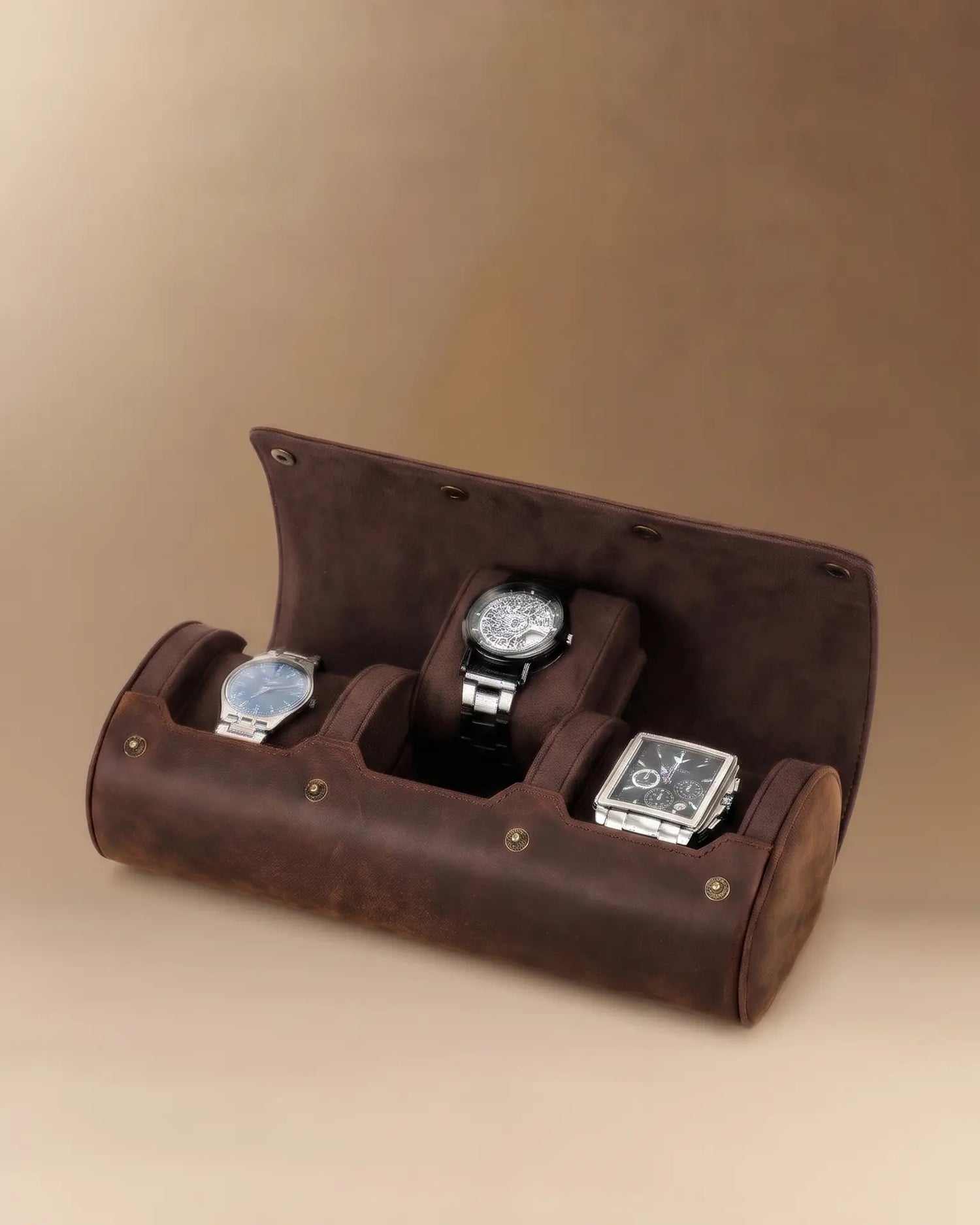

Journey Wrap Triple Watch Roll
Regular price
$59.95 USD
Regular price
Legacy Rivet Triple Watch Roll
Regular price
$119.00 USD
Regular price
$128.00 USD
Sale price
$119.00 USD
Available in
 Dark Brown
 Dark Brown
Legacy Rivet Single Watch Roll
Regular price
$79.00 USD
Regular price
$86.00 USD
Sale price
$79.00 USD
Available in
Dark Brown
Dark Brown
Journey Wrap Double Watch Roll
Regular price
$49.90 USD
Regular price
More Leather Guides
Explore practical guides to choosing, using and caring for leather goods.

Custom Leather Bookmark Guide: Thickness, Engraving and Magnet Options

Magnetic Bookmark With Pen Holder: Who It Is For and How to Use It
