How this guide is funded. BygoneMark makes leather watch storage, and all six picks below are ours. We are not going to pretend otherwise, so read this as a maker explaining a category rather than an independent roundup. What we can do is be honest about limits: we do not make a molded hard case, and where compression, water or grit are the real risk, a hard shell from another maker beats anything on this page. We say so in the format section. Competitor brands are named where they earn it. None of the links here are affiliate links, and no brand paid for placement.
Our Picks at a Glance
|
BEST OVERALL
|
BEST FOR HOME
|
BEST MINIMUM BULK
|
|
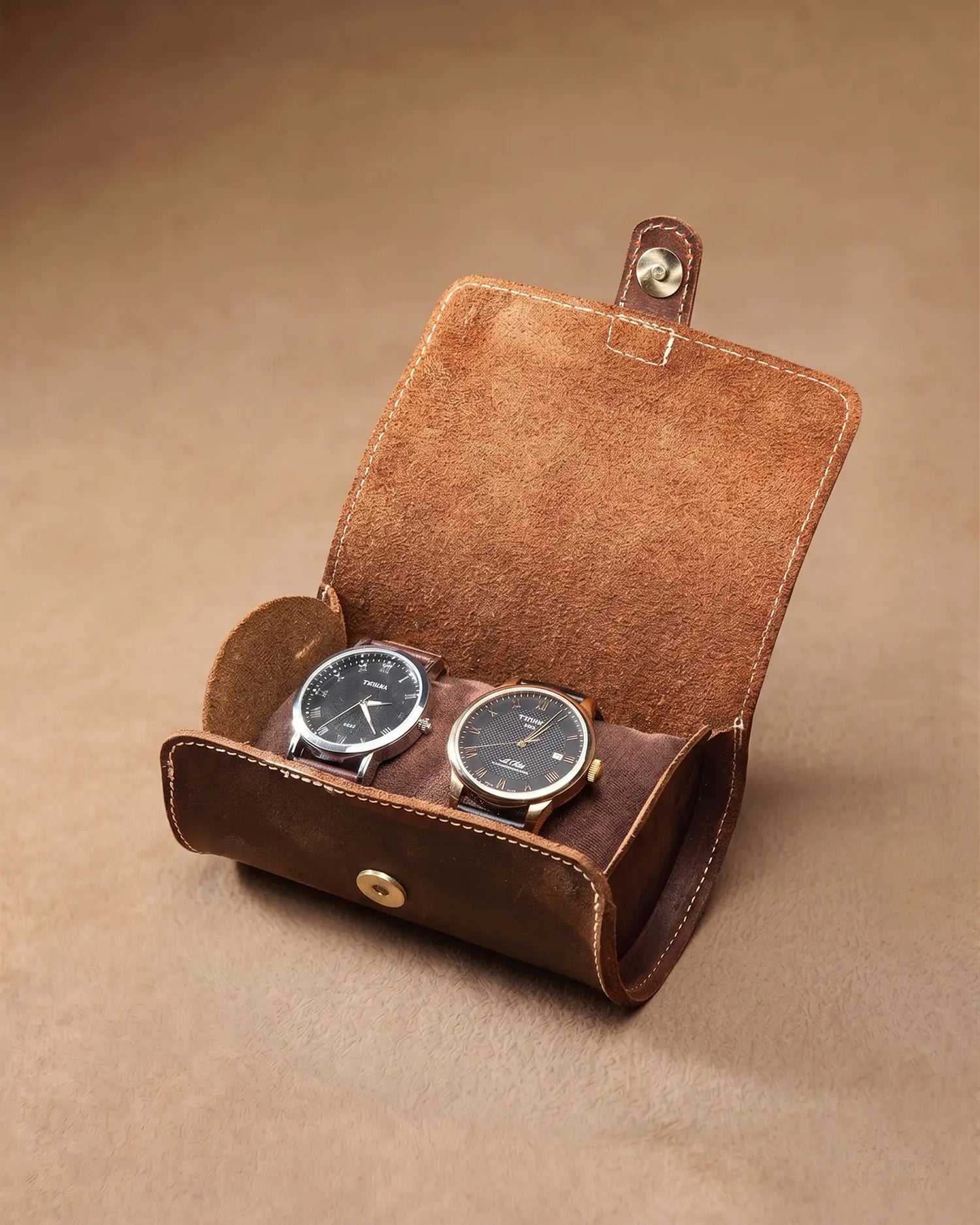
Journey Wrap Double Watch Roll
|
Legacy Hex Double Watch Box
|
Journey Single Watch Sleeve
|
|
$49.90
|
$109.90
|
$29.90
|
Every pick in this guide, by format. Prices carry the date they were checked.
|
Pick
|
Format
|
Packed size
|
Published fit
|
Price
|
|
Journey Wrap Double Watch Roll
|
Wrap roll
|
5.12 x 3.35 in
|
2 watches, up to 50 mm
|
$49.90
|
|
Legacy Rivet Double Watch Roll
|
Structured roll
|
Not published
|
2 watches, 6.5 in wrist and up
|
$91.00
|
|
Legacy Hex Double Watch Box
|
Hexagonal box
|
Not published
|
2 watches, up to 50 mm
|
$109.90
|
|
Legacy Lock Watch Case, Double
|
Structured lock case
|
Not published
|
2 watches, up to 50 mm
|
$119.90
|
|
Journey Single Watch Sleeve
|
Flat sleeve
|
Not published
|
1 watch, up to 50 mm
|
$29.90
|
|
Leather Travel Watch Pouch
|
Zipped pouch
|
5.9 x 3.3 x 0.8 in
|
2 watches, up to 50 mm
|
$49.90
|
Two things worth flagging before you read on. Only two of these six publish full closed dimensions, which is why the packed size column has gaps in it. We print "Not published" rather than estimating, and if a figure matters to your decision, our support team will measure a unit and tell you. The second point is more useful: every case here fits watches up to 50 mm, so case diameter is almost never what decides the purchase. Cushion circumference is. That distinction runs through the whole guide.
Which Watch Case Wins?
For most people the answer is a two-slot roll: the Journey Wrap Double ($49.90) separates two watches at 5.12 by 3.35 inches. Buy a box instead when the collection stays home and you want it visible. Buy a pouch or sleeve when one watch travels and packed size is the only thing that matters.
Watch damage in storage is rarely dramatic. It is a hairline across a polished lug. A clasp that pressed a mark into a caseback somewhere over the Atlantic. A crystal marked by the zip pull it spent four hours against.
The format on the label decides very little. What matters is what happens inside: whether the watch can move, whether the bracelet is held open all night, and whether the shell keeps its shape when a packed bag leans on it. Most people shopping for
watch storage that fits how you travel start with the leather and finish with a return.
Setting is the first fork. Travel, home, or pocket.
Pick by owner type
|
You are
|
Buy this
|
Why
|
|
Flying with two watches
|
Two-slot roll
|
Separates a rotation without taking over the bag
|
|
A home collector
|
Hexagonal or lock box
|
Fixed address, visible, room for the next purchase
|
|
Carrying one watch daily
|
Flat sleeve
|
Smallest footprint, keeps keys and coins off the case
|
|
Packing a full suitcase
|
Structured roll
|
Soft wraps compress more readily; structured cases hold their shape better during ordinary packing, but neither has a published crush-resistance rating
|
|
On a 6 to 6.5 in wrist
|
Compressible or removable cushion
|
Short bracelets fail on oversized pillows
|
|
Buying a gift
|
Two slots, either format
|
Fits almost any collection without assuming its size
|
Count the watch on your wrist. Most people shopping for a three-slot roll are actually taking two watches and wearing one of them half the time. A smaller case saves the luggage space you will want back on day four.
How We Judged These Six Cases
Fit first. This comparison is built on manufacturer-published dimensions, the supplied SERP and competitor research, owner reviews on the official listings, and prices checked on 25 August 2026. Where a figure is not published we print "Not published" rather than guessing at it.
Fit range
How many case and bracelet sizes the interior genuinely accepts, not the number printed on the listing. A published maximum case size and a stated wrist floor scored higher than a vague "fits most watches".
Movement control
Whether the watch stays put when the closed case is tilted through ninety degrees. A soft lining that lets a watch slide scored as no protection at all, regardless of how good the leather is.
Structure
Whether the shell feels firm or folds under light hand pressure. This is a qualitative handling check, not a compression-resistance test.
Everyday use
Loading speed, closure security, and how the case behaves in a bag that is already full. A case that needs two hands and a flat surface gets left at home.
Every card carries an evidence line: manufacturer specifications, supplied research, or owner fit reports. Marketing dimensions on their own do not settle anything.
Start With Setting, Not Material
Think about the roughest hour in a normal week for that watch. That hour is what the case has to survive.
Wrap and structured rolls: the travel default
A roll holds one to three watches on cushions and closes into a compact shape. The good ones put a full-height divider between slots so nothing drifts. Wrap styles fold flat and pack small. Structured styles hold their shape better than soft wraps during ordinary packing; no crush-resistance rating is claimed. Both beat scattering watches through a wash bag, a jacket pocket and a shoe.
The trade-off is capacity. Three slots is the ceiling, and an empty slot in a loaded roll can let cushions shift.
Boxes: protection you can leave on a dresser
At home the threat model changes completely. Nothing is crushing a watch on a nightstand. Dust, loose coins, a dropped set of keys and the edge of a hard surface are the real risks, and a box handles all four by giving each piece a fixed address. Boxes also scale, which rolls do not.
They do not travel. That is not a flaw, it is the design.
Pouches and sleeves: one job, done small
A sleeve follows the shape of the watch instead of building space around it, so the packed footprint is as small as this category gets. It stops a case rubbing against keys, coins and a charging brick. It does not stop a water bottle pressing through the leather.
Where a hard case beats all three
A purpose-built hard shell may be more appropriate where compression and grit are material risks. BygoneMark does not currently make one. For checked luggage or rough handling, compare published construction and test evidence from specialist makers.
|
Format
|
Main strength
|
Main trade-off
|
Best for
|
|
Wrap roll
|
Packs flat, low bulk
|
Less rigid than a structured shell
|
Carry-on travel, weekends
|
|
Structured roll
|
Fixed-shape construction for ordinary packing
|
Costs more, bulkier when empty
|
Full suitcases, frequent flyers
|
|
Hexagonal box
|
Fixed address, will not roll off
|
Not packable
|
Dresser, shelf, safe
|
|
Lock case
|
Presentation, keepsake feel
|
Heaviest of the three home options
|
Gifts, formal storage
|
|
Sleeve
|
Smallest packed size
|
No crush resistance at all
|
Commutes, gym, one watch
|
|
Zipped pouch
|
Full enclosure, opens flat
|
Zip teeth sit near the watch
|
Business trips, two watches
|
The "3 watch rule" is not an official standard. It is shorthand for a rotation that covers most situations: one everyday watch, one sport watch, one dress watch. Useful as a packing filter. Not a reason to buy slots you will not fill.
Best Watch Rolls for Travel
Two answers to the same brief. A $49.90 wrap that packs flat, and a structured shell for bags you do not control.
BEST OVERALL · OUR OWN PRODUCT
1. Journey Wrap Double Watch Roll
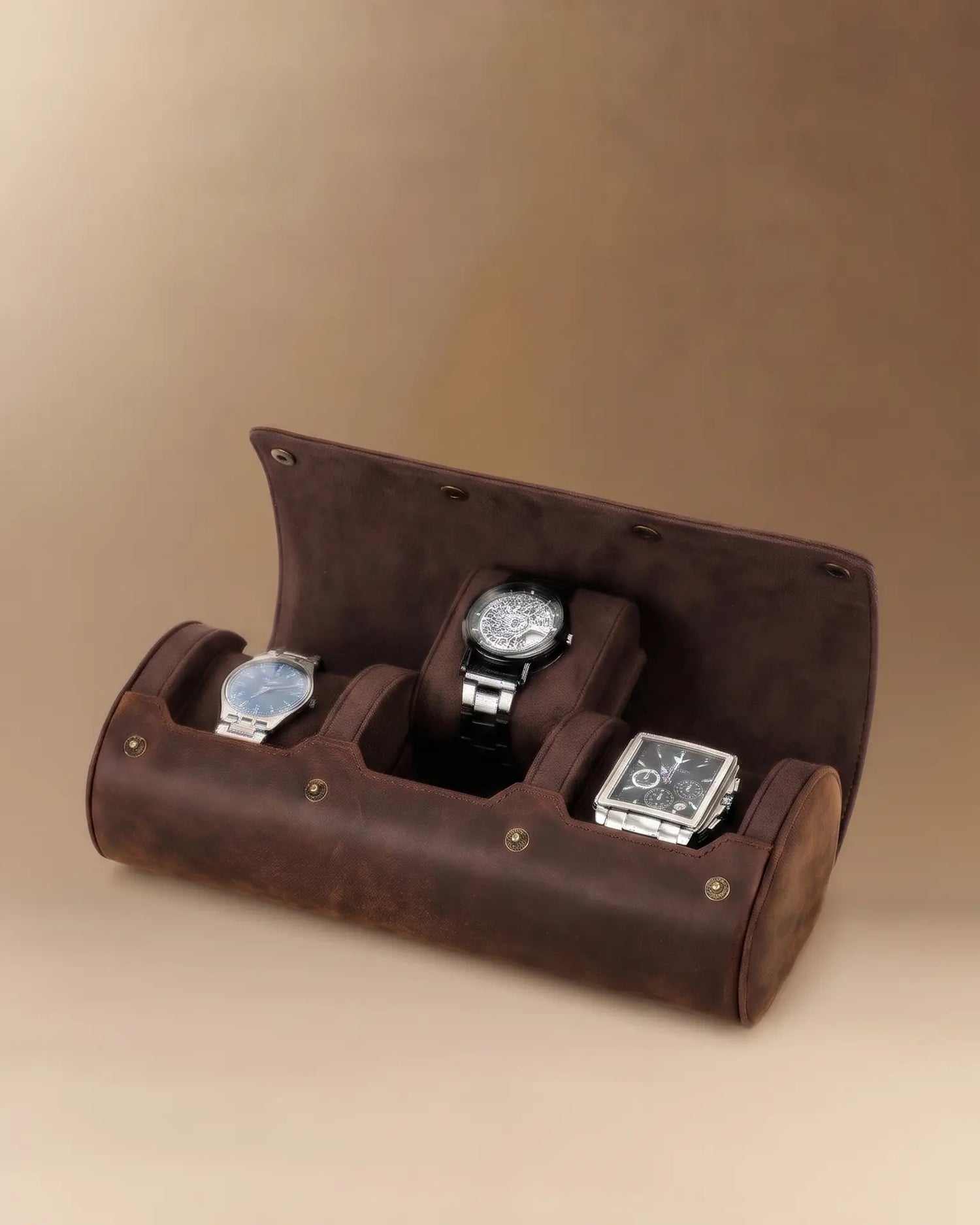
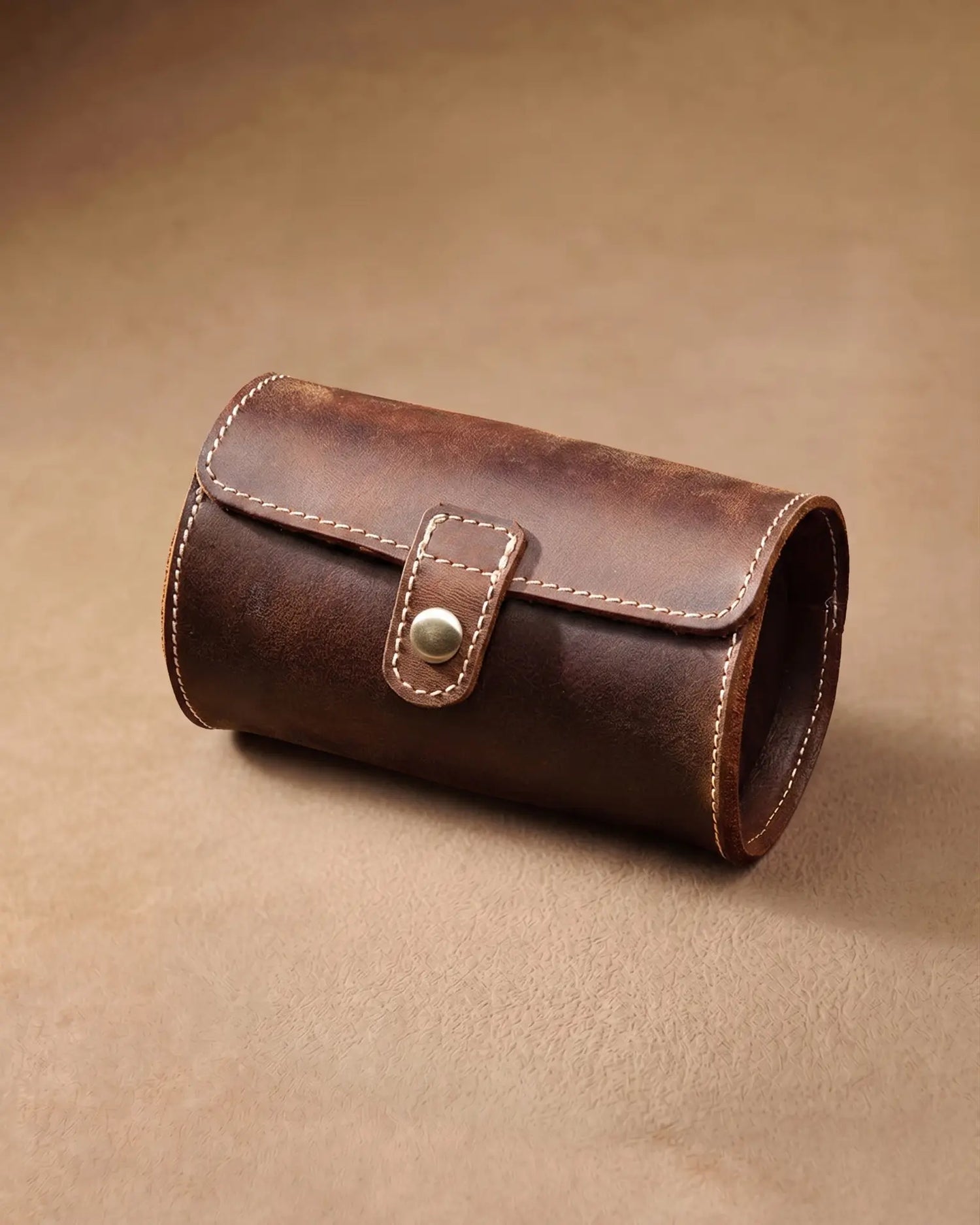
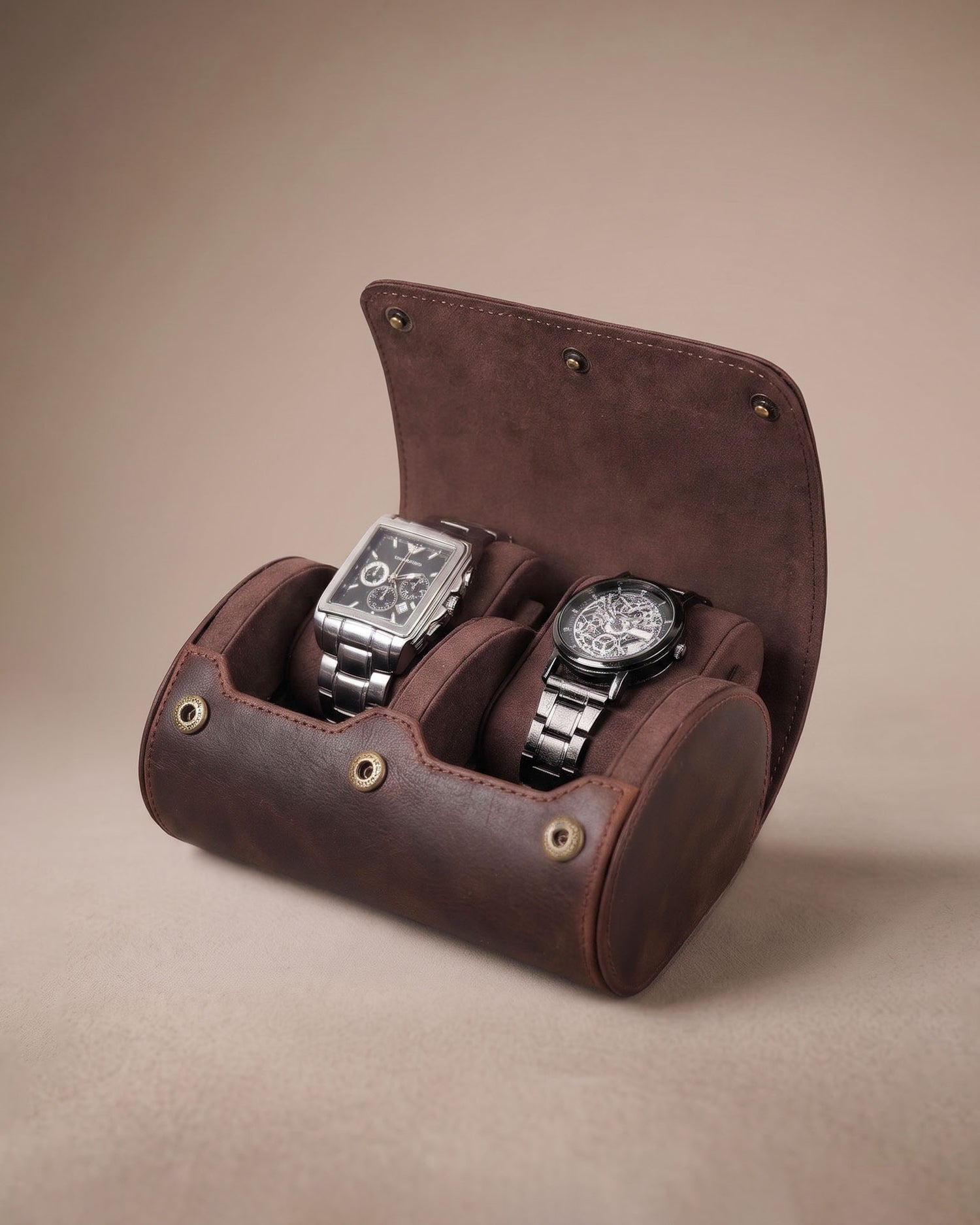
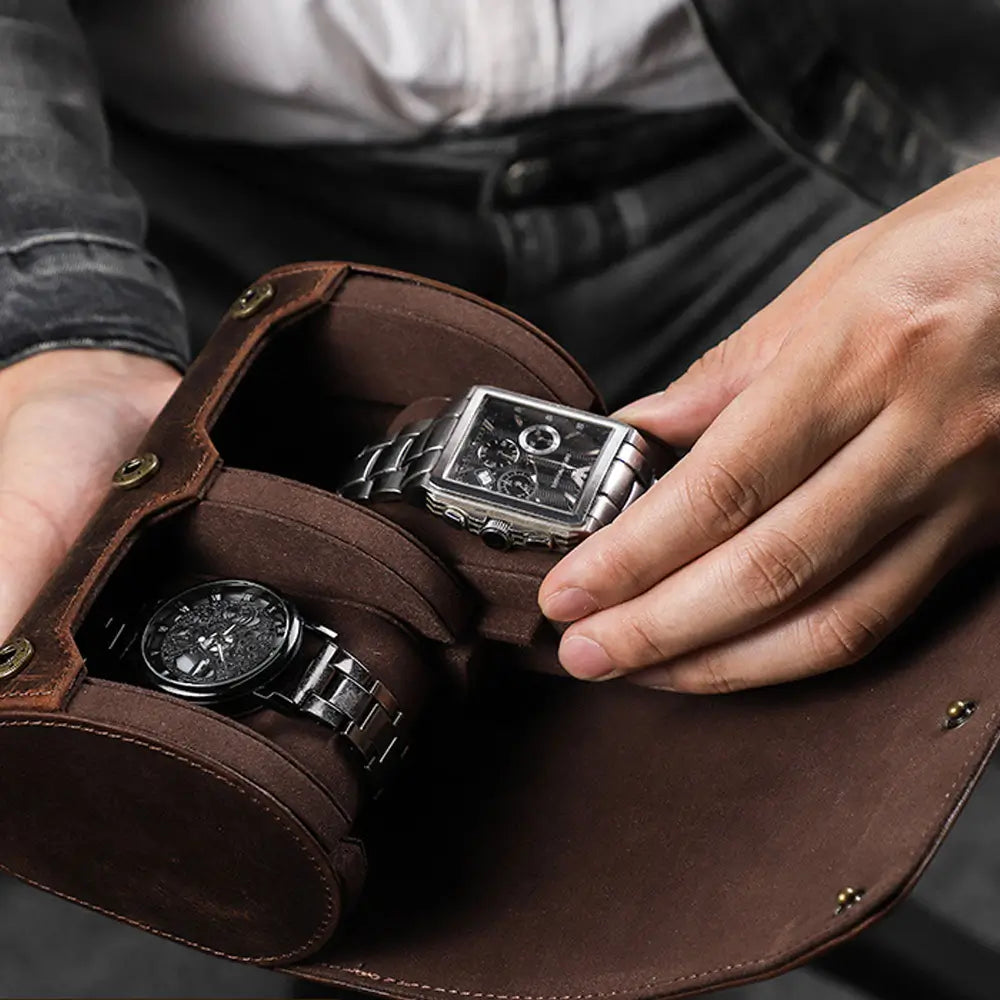
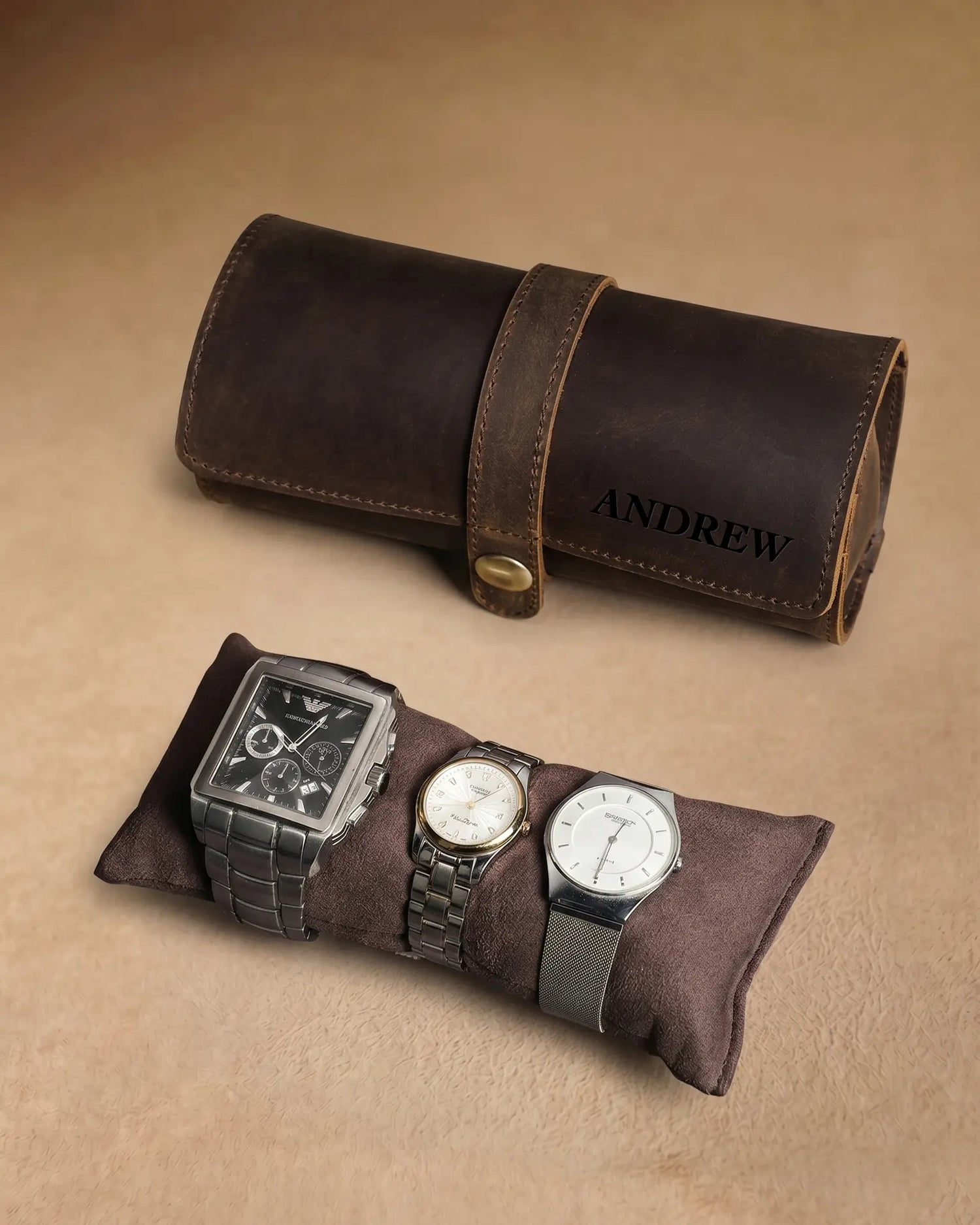
The most complete spec sheet in this guide, and the case we sell most of by a wide margin. Two watches sit either side of a removable suede pillow, the wrap folds over both, and a solid brass snap holds it shut.
|
Exterior
|
Full grain crazy horse leather
|
|
Lining
|
Soft suede, removable center pillow
|
|
Packed size
|
5.12 x 3.35 in
|
|
Weight
|
0.2 lb
|
|
Fit
|
2 watches, each slot up to 50 mm case diameter
|
|
Closure
|
Solid brass snap
|
|
Construction
|
100% hand-stitched, traditional saddle stitch
|
|
Extras
|
Engraving in 1 to 3 days, gift box, 1-year warranty
|
WHAT WORKS
✓ Removable pillow keeps the two watches apart, which is the whole job of a two-slot case
✓ At 0.2 lb it disappears into a laptop bag or a handbag
✓ Brass snap opens one-handed; test the closure while loaded before travel.
✓ Crazy horse pull-up means a scratch lightens, then blends back rather than staying
WHAT TO WEIGH
– A wrap is not a hard shell. Pack it between clothing and avoid heavy outside pressure.
– No cushion circumference published, so bracelets under 6.5 in need a check first
– Two slots and no room for a spare strap or a tool
Best for: Anyone who wears one watch and travels with one more, which is most travelers most of the time.
Evidence: Manufacturer specifications; 28 owner reviews on the official listing.
BEST STRUCTURED
2. Legacy Rivet Double Watch Roll
The firmer end of the range, with a rivet detail and a padded interior. It has no published compression-, impact- or crush-resistance rating. The single version publishes a wrist floor of 6.5 inches; confirm fit for the double on its current product page.
|
Exterior
|
Full grain leather, vintage rivet detail
|
|
Lining
|
Cushioned padded interior
|
|
Packed size
|
Not published
|
|
Weight
|
Not published (single version: 0.36 lb)
|
|
Fit
|
2 watches, wrists 6.5 in and up
|
|
Closure
|
Wrap with rivet fastening
|
|
Construction
|
Hand-stitched in workshop
|
|
Extras
|
Airport screening requirements vary; follow the instructions of airport security staff.
|
WHAT WORKS
This is the structured option in the range; no compression-, impact- or crush-resistance rating is published.
✓ Published wrist floor, which almost nothing in this category gives you
✓ 65 owner reviews, the highest count in our watch storage line
✓ Reads as a considered object rather than as travel equipment
WHAT TO WEIGH
– $91.00 against $49.90 for the wrap, for structure rather than capacity
– Closed dimensions not published, so check before buying for a tight bag pocket
– Bulkier than a wrap when it is empty, because the walls do not fold
Best for: Frequent flyers who pack heavy, and anyone whose bag gets handled by someone else.
Evidence: Manufacturer specifications; published wrist range on the Legacy Rivet Single listing; 65 owner reviews.
What a Good Roll Interior Looks Like
One defined position per watch, with a divider that runs the full height of the compartment. Not a shared cushion with a fold in the middle. The case, crown, bezel and clasp should stay clear of each other when the roll is turned on its side.
A divider that folds under light hand pressure should be treated as flexible. This hand check is not a compression test; pack the case to limit outside pressure.
Best for Small Wrists
This is where rolls fail most often. A fixed pillow built around a 7.5 inch bracelet will not close naturally around a 6 inch one, which leaves the clasp under steady load and the spring bars carrying tension every night the watch sits there.
Removable or compressible cushions solve it. The Journey Wrap pillow comes out, which is the single most useful feature in this guide for anyone with a short bracelet.
Verdict for rolls. The Journey Wrap Double is the right buy for most people: it publishes its dimensions, it weighs almost nothing, and the removable pillow adapts to bracelets that a fixed cushion would stretch. Move to the Legacy Rivet Double when the case travels in a bag you do not pack yourself, and accept that you are paying $41 more for walls rather than for slots.
Best Watch Boxes for Home
Two reads on the same idea. A hexagonal box that will not roll off a nightstand, and a structured lock case built to be given rather than packed.
BEST FOR HOME
3. Legacy Hex Double Watch Box
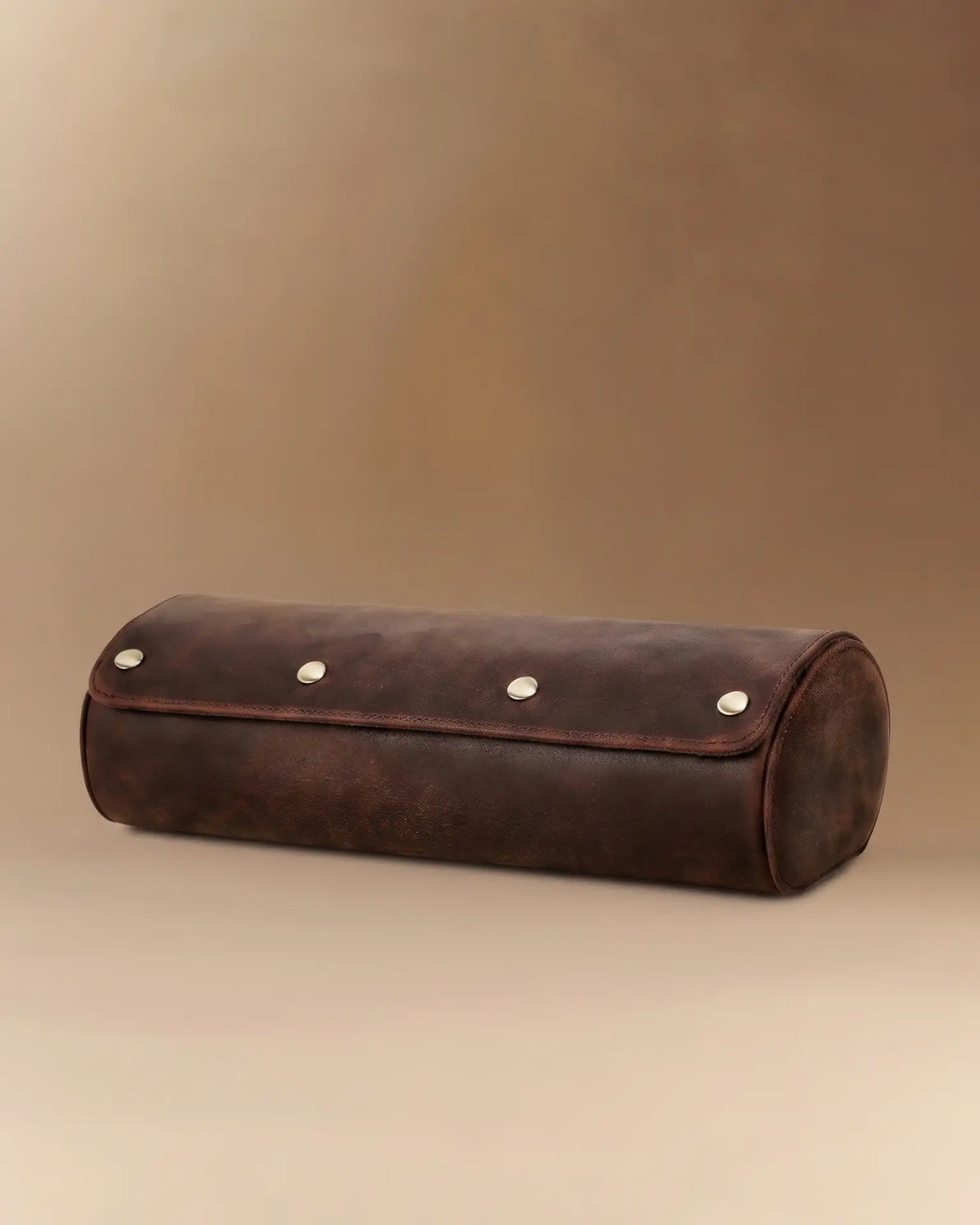
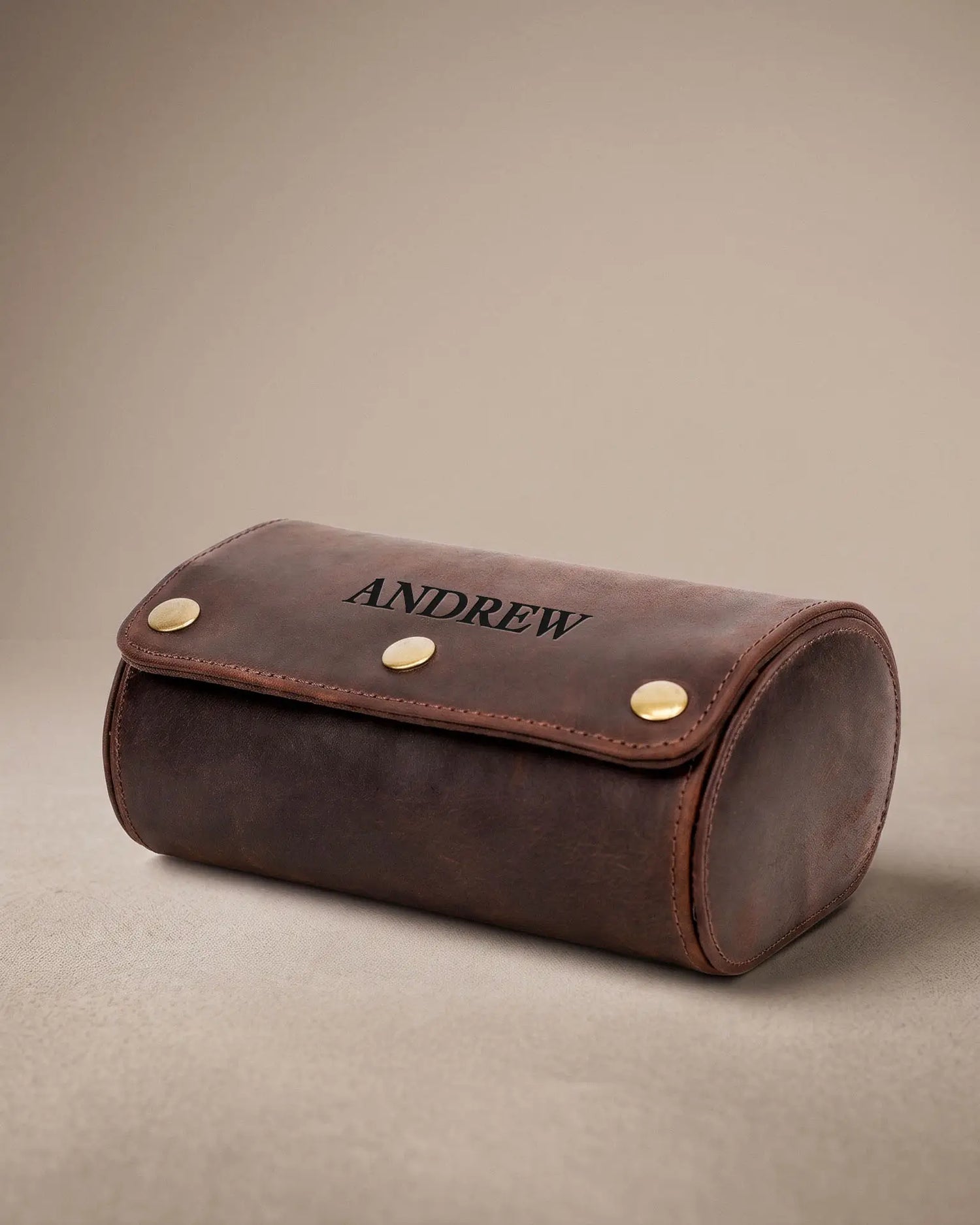
The hexagonal footprint is the point. A cylindrical case rolls off a dresser at midnight; a hex sits flat on any of its faces and stays where it was put. Two watches rest on individual suede pillows inside.
|
Exterior
|
Full grain leather, hexagonal body
|
|
Lining
|
Suede, individual pillows per slot
|
|
Packed size
|
Not published
|
|
Weight
|
Not published
|
|
Fit
|
2 watches, up to 50 mm case diameter
|
|
Closure
|
Lid with structured body
|
|
Construction
|
Hand-stitched, engraving available
|
|
Extras
|
Personalization in 1 to 3 days, gift box included
|
WHAT WORKS
✓ Flat faces mean it does not roll, which sounds trivial until it happens
✓ Individual pillows rather than a shared cushion, so neither watch touches the other
✓ Small enough for a dresser or a home safe, unlike a six-slot display box
✓ 41 owner reviews at a full five-star average
WHAT TO WEIGH
– No published dimensions, so measure your shelf or safe opening before ordering
– Closed body, so you open it to see what is inside
– Two slots only. A growing collection outgrows this within a year or two
Best for: A settled two-watch rotation that lives on a dresser and comes off every night in the same place.
Evidence: Manufacturer specifications and collection FAQ; 41 owner reviews. Dimensions not published.
BEST PRESENTATION
4. Legacy Lock Watch Case, Double
The most formal piece in the range, and the one people buy as a gift rather than for themselves. A structured body with a lock-style closure that reads closer to a keepsake box than to storage.
|
Exterior
|
Full grain leather, some Legacy styles use oil bead leather
|
|
Lining
|
Soft padded interior with individual slots
|
|
Packed size
|
Not published
|
|
Weight
|
Not published
|
|
Fit
|
2 watches, up to 50 mm case diameter
|
|
Closure
|
Lock-style fastening
|
|
Construction
|
Hand-stitched, engraving available
|
|
Extras
|
Available in Dark Brown, gift box, 1-year warranty
|
WHAT WORKS
✓ Oil bead leather gives a smoother, more formal finish than crazy horse
✓ Structured body holds its shape whether it is full or empty
✓ The closure is deliberate enough that it does not open by accident
✓ 56 owner reviews, second highest in the range
WHAT TO WEIGH
– $119.90 is presentation money, not protection money. The Hex protects the same two watches
– Not a travel piece. It is the thing that gets a place, not the thing you throw in a backpack
– No published dimensions or weight
Best for: Anniversaries, retirements and groomsmen gifts, where the case is part of the present.
Evidence: Manufacturer specifications and collection FAQ; 56 owner reviews. Dimensions not published.
When to Size Up
There is a limit to that logic. A box with several empty slots takes up dresser and safe space for no return, and loose pillows in unused compartments rattle. Buy one size ahead. Not four.
Verdict for boxes. The Legacy Hex Double is the better buy of the two on function: same capacity, same 50 mm ceiling, same individual pillows, $10 less, and a footprint that will not roll. Choose the Lock case when the box is a gift and the opening matters as much as the storage. Neither one belongs in a suitcase.
Best Pouches and Sleeves
The two smallest formats we make. One follows the shape of a single watch, the other zips two flat.
BEST MINIMUM BULK
5. Journey Single Watch Sleeve
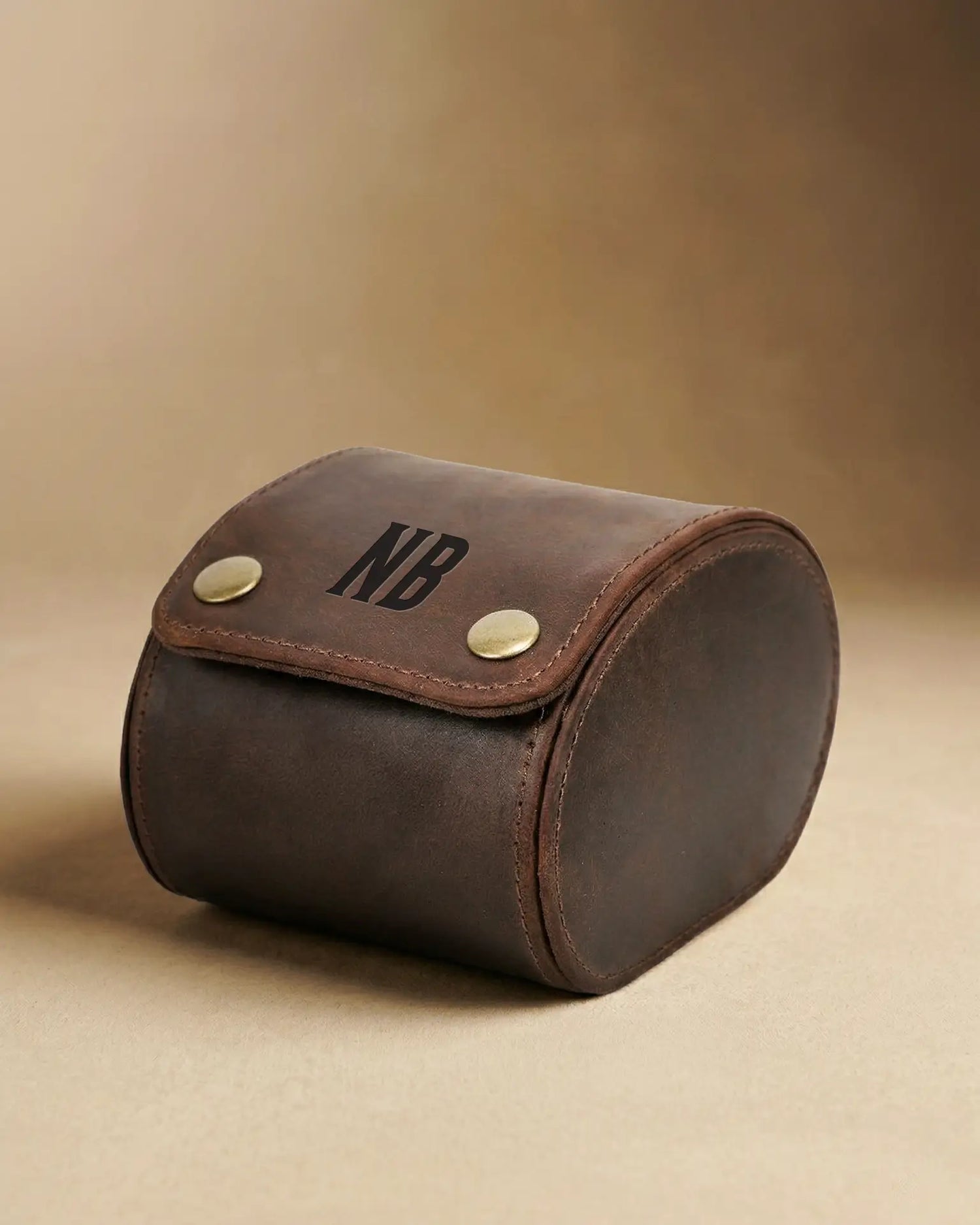
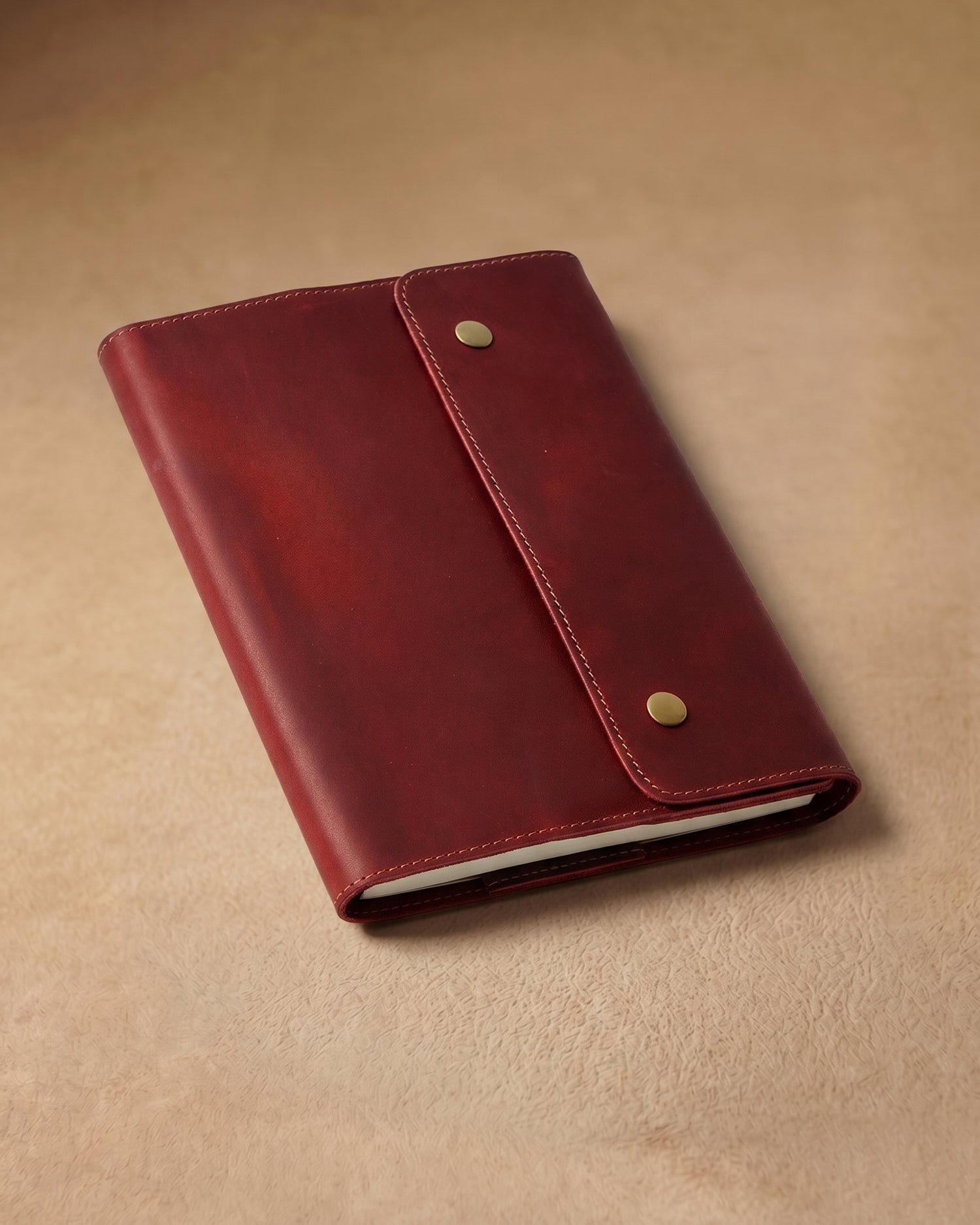
The lightest, cheapest real enclosure in the range. One watch, soft lining, and a packed footprint that is essentially the watch itself plus a few millimeters of leather.
|
Exterior
|
Full grain crazy horse leather
|
|
Lining
|
Soft suede
|
|
Packed size
|
Not published, slimmest format in the range
|
|
Weight
|
Not published
|
|
Fit
|
1 watch, up to 50 mm case diameter
|
|
Closure
|
Fold-over sleeve
|
|
Construction
|
Hand-stitched, engraving available
|
|
Extras
|
Free worldwide shipping applies at $29.90
|
WHAT WORKS
✓ Lowest entry price for a genuine leather enclosure
✓ Fits a jacket pocket, a briefcase sleeve or a glovebox and stays there
✓ Keeps a watch off keys, coins and a charging brick, which is where most daily scratches come from
✓ 33 owner reviews at five stars
WHAT TO WEIGH
– Scratch protection only. A heavy object pressing through the leather reaches the crystal
– One watch, no dividers, no adjustment
– A fold-over closure is not a zip. It stays shut in a pocket, less so in a loose bag
Best for: Commutes, the gym, overnight trips, and as a second case that never leaves a bag. Two watches in the same slim format is the
Journey Double Watch Sleeve at $39.90.
Evidence: Manufacturer specifications and collection FAQ; 33 owner reviews. Dimensions not published.
BEST ZIPPED POUCH
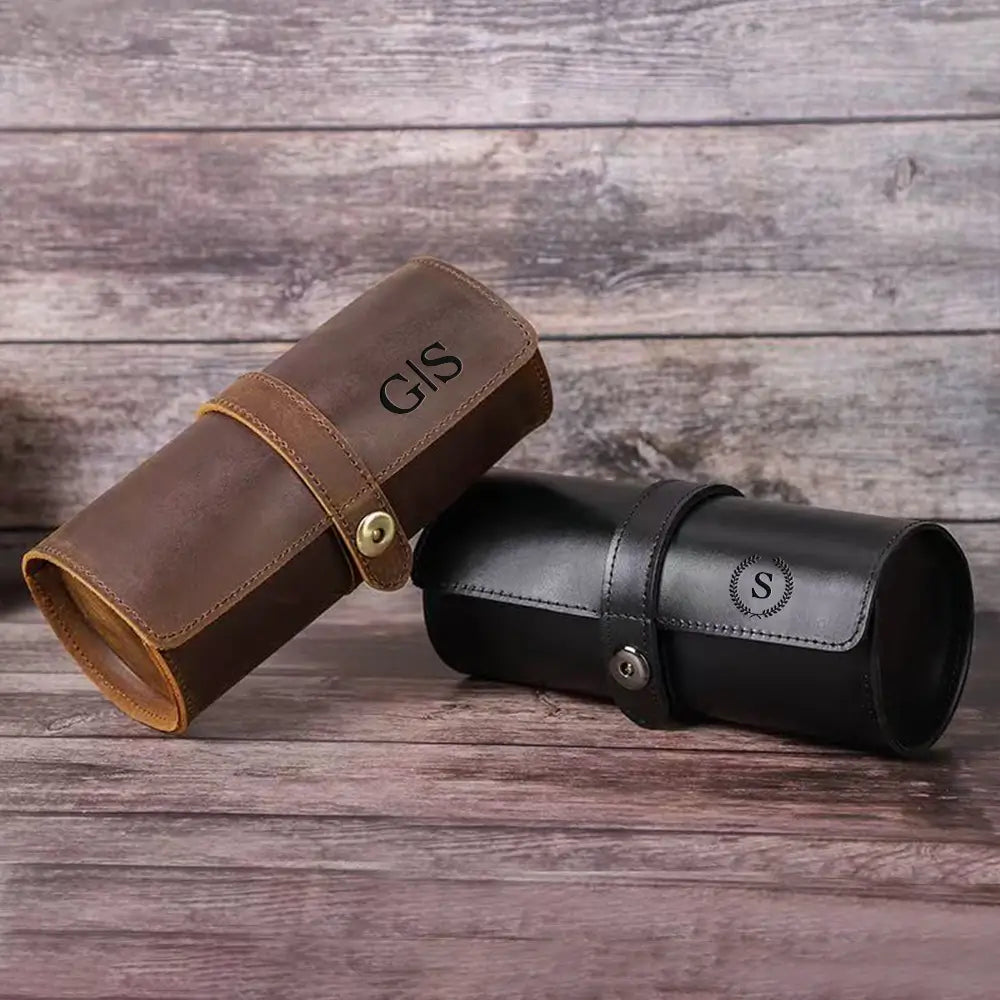
6. Leather Travel Watch Pouch
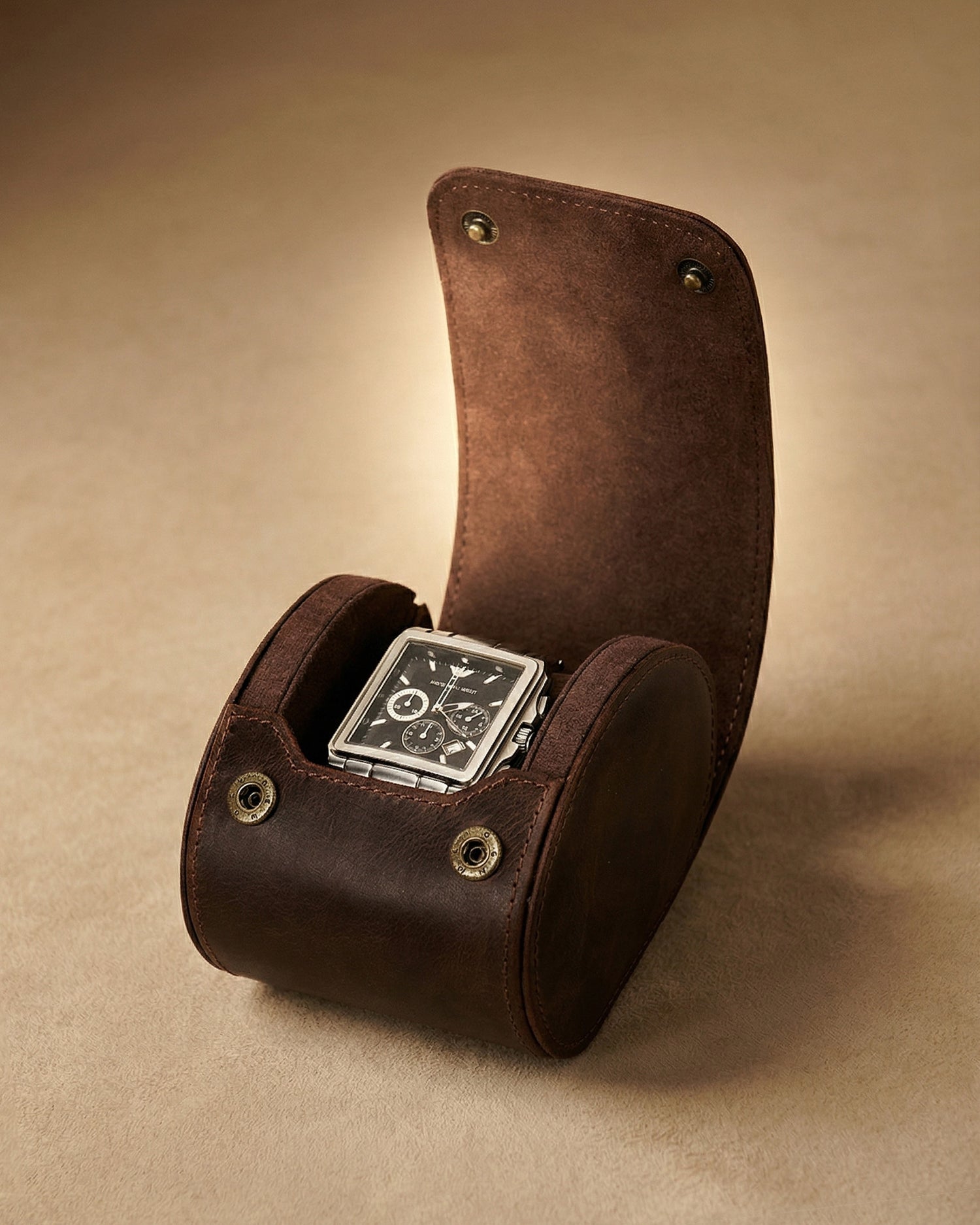
Two watches, full enclosure, and the only case in this guide whose zip wraps three sides so it opens completely flat. At 0.8 inches thick it slides into a jacket pocket.
|
Exterior
|
Full grain crazy horse leather
|
|
Lining
|
Soft suede with padded dividers between compartments
|
|
Packed size
|
5.9 x 3.3 x 0.8 in (15 x 8.5 x 2 cm)
|
|
Weight
|
Not published
|
|
Fit
|
2 watches, up to 50 mm case diameter
|
|
Closure
|
Metal zipper wrapping three sides
|
|
Colors
|
Dark Brown, Black
|
|
Extras
|
Engraving completed within 1 day
|
WHAT WORKS
✓ Opens flat, so you place and lift a watch instead of posting it into a slot
✓ Padded divider between the two compartments, not just a shared lining
✓ 0.8 in thick packs into spaces a roll cannot reach
✓ Full enclosure, so nothing falls out if it is dropped open
WHAT TO WEIGH
– Zip teeth run close to the watches. Seat both pieces before closing
– Flat format gives a thick diver less vertical room than a roll cushion does
– Same $49.90 as the Journey Wrap Double, so this is a shape choice, not a value one
Best for: Business travel where the case has to disappear into a pocket, and anyone who prefers a zip to a snap.
Evidence: Manufacturer specifications; 32 owner reviews on the official listing.
Verdict for pouches and sleeves. The Journey Single Watch Sleeve is the one to buy if you want a padded home for one watch and nothing else, and at $29.90 it is the easiest purchase in this guide to justify. The Leather Travel Watch Pouch costs the same as our best-selling roll and answers a different question: flat and zipped, rather than rolled and snapped. Neither gives you crush protection. Pack both between clothing.
Fit Check: The Five Minutes That Prevent a Return
Fit is the weakest part of almost every watch storage guide online. A case can use excellent leather and still be the wrong purchase because the cushion is too large or the watch sits too high under the lid. Measure your own watch first.
Case diameter, thickness and crown width
Start with the largest watch you plan to store, then measure its thickness. A 15 mm diver sits far closer to a lid than a 9 mm dress watch of the same diameter. Add the crown and pushers to the width figure. A 42 mm chronograph often needs closer to 46 mm of horizontal space once those are counted.
Bracelet circumference against the cushion
The measurement almost nobody checks, and the one behind most returns in this category. The bracelet has to close naturally around a pillow. An oversized cushion puts steady tension on a bracelet sized for a 6.5 in wrist, and the clasp either strains or refuses to shut. Fixed metal bracelets are where this bites hardest. Leather, fabric and rubber adapt.
Deployant clasp clearance
A folding clasp needs interior room to sit flat. Forced into a tight position it leaves the watch at an angle and makes every load a fight. Ask for cushion dimensions when they are not published. We answer that question by email, and so do most makers worth buying from.
Clearance above the crystal
A thick watch can fit a compartment and still press against a lid or a zip track. Check the gap once the closure is fastened, not while the case lies open.
The tilt test
Load the case, close it, then tilt it slowly in four directions. Movement you can hear or feel means the fit is wrong. Do this at home, inside the return window, not in a departure lounge.
|
Measure
|
Take it from
|
Compare against
|
|
Case diameter
|
Widest watch, crown and pushers included
|
Usable interior width
|
|
Case thickness
|
Tallest watch on the cushion
|
Clearance under the closed lid or zip
|
|
Bracelet circumference
|
Shortest fixed bracelet you own
|
Cushion or pillow circumference
|
|
Lug-to-lug length
|
Longest watch, lug tip to lug tip
|
Compartment depth front to back
|
|
Exterior size
|
Not applicable
|
The bag pocket or shelf you actually use
|
If you have to push hard to close it: the interior is too tight. Pressure on the crystal and caseback is a slower kind of damage than a drop, and it is entirely self-inflicted.
Protection Features That Matter More Than Material
Material decides how the case looks in year five. Structure decides what happens when a suitcase gets stacked under three others. Different questions.
Structured shell against soft body. Soft cases are flexible and easier to pack. Structured cases keep a fixed footprint, but no model here has a published crush- or impact-resistance rating.
Separation between watches. On a folded bracelet the caseback and the links sit millimeters apart, and hours of small vibration is enough to mark polished steel. A full-height divider or an individual pillow holds them apart without pressing on either. A shared cushion with a fold in it does not.
Linings. Suede, microsuede and velvet all work. Softness is only half the job. The lining has to stay bonded so seams do not develop after a year of loading, and it has to stay clean, because grit trapped in soft fabric turns a lining into sandpaper.
Closures. Zips enclose the watch fully but put hard teeth near the opening, so the interior has to keep the case away from them. Snaps are quick and easy to verify by feel. Test any closure loaded, never empty.
|
Feature
|
What it actually does
|
What to check
|
|
Structured shell
|
Fixed-shape construction for ordinary packing; no published crush or impact rating
|
Press the wall. It should not fold
|
|
Full-height divider
|
Stops watch-to-watch contact
|
Push it sideways. Decorative ridges give way
|
|
Removable pillow
|
Adapts to different bracelet lengths
|
Does it come out, and does it compress
|
|
Lining bond
|
Prevents seams reaching the crystal
|
Feel the corners and compartment edges
|
|
Closure
|
Keeps the case shut under pressure
|
Test it loaded, never empty
|
|
Plain exterior
|
Reduces theft interest in transit
|
No loud branding, no obvious watch shape
|
Which Materials Travel Best
Full grain crazy horse leather is the backbone of this range. It is full grain hide with a waxed pull-up finish, which means a scratch shows lighter, then blends back when you rub it with a thumb. It ages into a patina rather than wearing out, and it hides the marks that travel puts on a case.
Full grain oil bead leather appears on some Legacy styles. Smoother, more even, more formal. Fewer natural marks when new, slightly less character over time.
Suede and microsuede linings are the safe surface for crystals and polished steel. Non-abrasive, soft enough to absorb small movement, and easy to brush clean.
A purpose-built hard shell may be more appropriate where compression or water exposure is a material risk. BygoneMark does not currently make one; compare published ratings before buying.
Grade alone should not close the decision. Price and leather grade alone do not establish impact or crush performance; compare construction and published test evidence.
What You Should Expect to Pay
Price tracks construction more reliably than it tracks branding. Above roughly $100, compare finish, hardware, presentation, fit and any published performance evidence rather than assuming price determines performance. That is a legitimate thing to want. Just know which one you are buying.
|
Tier
|
Typical price
|
What you get
|
Watch out for
|
|
Entry
|
$29 to $50
|
Full grain leather, suede lining, one or two slots, fixed format
|
No structure, dimensions often unpublished
|
|
Value
|
$50 to $95
|
Removable pillow, dividers, published dimensions, brass hardware
|
Cushion circumference rarely published
|
|
Enthusiast
|
$95 to $130
|
Structured body, individual pillows, formal finish
|
Presentation priced above protection
|
|
Premium
|
$130 plus
|
Larger capacity, oil bead leather, keepsake construction
|
Capacity you will not fill for years
|
A $150 case does not automatically fit better than a $30 one. Measurements decide fit. Price decides finish.
Roll vs Box vs Pouch Side by Side
Rolls win on packed size for a rotation. Boxes win at home and lose everywhere else. Pouches win on absolute bulk and lose on structure. If you are weighing capacity against packed size across all three, our
full leather watch case collection runs to 15 pieces in single, double and triple formats.
|
|
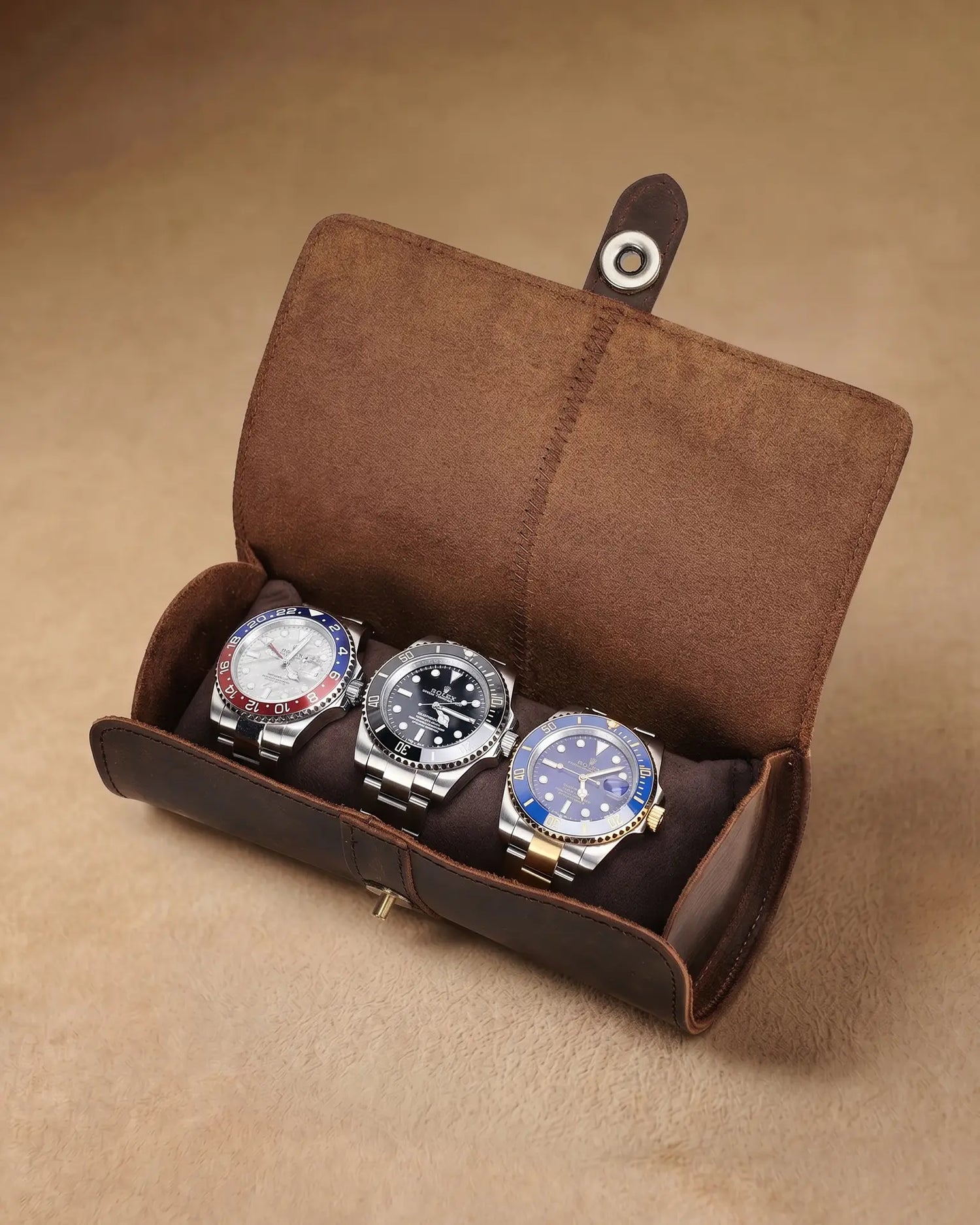
Watch roll
|
Watch box
|
Pouch or sleeve
|
|
Typical capacity
|
1 to 3
|
1 to 3 in our range, 6 to 24 elsewhere
|
1 to 2
|
|
Packed size
|
Small
|
Poor for travel
|
Smallest
|
|
Structure in ordinary handling
|
Varies by construction; no published test rating
|
Fixed shape for stationary storage; no published test rating
|
Soft unless separately reinforced; no published test rating
|
|
Best environment
|
Carry-on, between clothing
|
Dresser, shelf, safe
|
Pocket, briefcase, gym bag
|
|
Visibility
|
Closed
|
Closed or open compartments
|
Closed
|
|
Accessory room
|
Limited
|
Best of the three
|
None
|
|
Long-term storage
|
Workable in a drawer
|
Purpose-built
|
Not designed for it
|
How to Choose in Seven Steps
-
Count the trip, not the collection. Decide how many watches you will genuinely wear, then subtract the one on your wrist.
-
Measure your biggest watch. Largest diameter and thickest case, crowns and pushers included.
-
Measure your shortest bracelet. The smallest fixed bracelet circumference in your rotation.
-
Decide the setting. Travel, dresser, or pocket. That single answer eliminates two of the three formats.
-
Match structure to how you pack. Soft between clothing, structured for a shared bag, hard shell for checked luggage.
-
Inspect the inside before the outside. Divider height, pillow removability and closure security before you look at the leather.
-
Set the budget against those functions. Then let color and finish break the tie.
How to Pack Watches for a Trip
The case only does half the work. Where it sits in the bag does the rest.
-
Fasten every bracelet or strap before the watch goes in. A loose end is something that hunts for a crystal.
-
Check the closure line. Crown, bezel and crystal should sit clear of a zip track or a snap.
-
Fill the void. A rolled microfiber cloth in an empty slot is free and it ends the rattle.
-
Bed a soft case between clothing. Keep it away from shoes, chargers and toiletry bags.
-
Keep spring bars and tools in a separate zipped pocket. Never loose beside a crystal.
Carry it in hand luggage. The
TSA advises keeping valuables with you rather than checking them, and you can ask an officer to screen you and your valuables in private instead of opening a case into a public tray. The agency’s
travel checklist adds that bulky jewelry comes off before the scanner and that valuables belong in the carry-on rather than a loose bin.
Tilt before you travel, every time. Thirty seconds of checking beats a hairline you notice three days later on a hotel dresser.
Looking After the Case Itself
Leather is hygroscopic. It takes moisture from the air and gives it back, and it changes dimensionally while doing so. The
Canadian Conservation Institute recommends a stable relative humidity of 45 to 55 percent and a temperature of 18 to 20 degrees Celsius for tanned leather. Below roughly 30 percent the fibers embrittle. Above about 65 percent you are into
mold territory and hydrolytic breakdown of the fiber structure. Swings between the two are worse than sitting slightly off target, because repeated cycling progressively hardens vegetable tanned leather.
The
US National Park Service makes the same point about heat in its curatorial guidance for leather and skin objects. Sustained warmth and damp accelerate oxidation.
In practice that rules out three popular storage spots: a bathroom shelf, a sunlit windowsill, and the top of a radiator cabinet. A drawer in a normally heated bedroom is fine.
Wipe crazy horse leather with a dry or barely damp cloth, keep it away from standing water and direct heat, and blend a light scratch by rubbing it with your thumb. Let a leather strap air for a few minutes after wear before you close a lid on it. Our
leather care guide covers the rest.
Six Mistakes We See Most Often
-
Buying on capacity instead of behavior. Three slots is not better than two if you carry two.
-
Oversized cushions. The most common complaint in collector threads, and the one that kills short metal bracelets.
-
Ignoring thickness. Diameter gets published, thickness usually does not, and thickness is what meets the lid.
-
Treating soft leather as crush protection. Thickness is not structure.
-
Forcing a closure. That pressure lands on the crystal or the crown for the whole flight.
-
Storing the case somewhere humid. A bathroom shelf undoes good leather faster than a year of travel.
Glossary: What the Spec Sheet Means
|
Term
|
What it means in practice
|
|
Cushion circumference
|
The distance around the pillow. Your bracelet has to close over this
|
|
Full-height divider
|
A barrier running the full depth of a compartment, so watches cannot touch
|
|
Lid clearance
|
The gap between the crystal and the closed lid. The figure nobody publishes
|
|
Lug-to-lug
|
Tip of the top lug to tip of the bottom lug. Decides compartment depth
|
|
Deployant clasp
|
A folding bracelet clasp. Needs flat interior room to sit correctly
|
|
Crazy horse leather
|
Full grain hide with a waxed pull-up finish. Scratches lighten, then blend back
|
|
Oil bead leather
|
Full grain hide with a smoother, more formal finish and less pull-up
|
|
Pull-up effect
|
The lightening of color where waxed leather is bent or scratched
|
|
Patina
|
The surface character leather develops with use, not a defect
|
Key Takeaways
-
Setting first, then measurements. Travel, dresser or pocket eliminates two formats immediately.
-
Bracelet circumference against the cushion is the check almost nobody runs, and it causes most returns.
-
Divider height, not lining softness, decides whether two watches touch.
-
Structure affects how a case holds its shape; leather grade affects how the exterior ages. Neither statement is a test rating.
-
Every case in this guide fits up to 50 mm, so diameter is rarely the deciding number.
-
We do not make a hard shell. For checked luggage, buy one from a maker who does.
-
Keep leather between 45 and 55 percent humidity. A bathroom shelf is the worst common storage spot.
Final Word: Setting First, Leather Last
The best watch case is the one that fits your watch and matches where that watch spends its time. Not the most expensive one, and not the one with the nicest grain.
Start with setting. A roll keeps packing simple. A box gives a collection a fixed address and room to grow. A sleeve or a pouch solves one watch and minimum bulk. Then work down through the details that actually touch the watch: divider height, cushion circumference against your shortest bracelet, clearance above the crystal, and a body that holds its shape in a packed bag.
Two figures decide almost every return in this category: the thickness of your watch including the crystal, and the circumference of your shortest closed bracelet. Fit depends on watch thickness and closed-bracelet circumference; price alone does not determine suitability.
Buy for the week you actually have, not the collection you hope to own. And when the case arrives, load it, close it, tilt it.
Full grain crazy horse leather, suede lining, watches up to 50 mm. Single, double and triple cases from $29.90, with engraving in one to three days and free worldwide shipping over $29.90.
Shop leather watch cases
FAQs
Are watch rolls good?
Yes, for travel. A roll carries one to three watches with far less bulk than a box while keeping each piece cushioned and separated. Quality varies, and the exterior tells you little. What matters is inside: soft lining without hard seams, a pillow that compresses instead of forcing a bracelet open, full-height dividers, and a closure that holds when a bag is squeezed. A roll is the wrong answer for a large collection that never leaves home.
Practical tip: load it, close it, shake it gently. Movement means the fit is wrong.
What are watch rolls?
Compact cases that hold a small number of watches on padded cushions, then close into a wrap, cylindrical or hexagonal shape. They came out of the trade, used by traveling salespeople to move inventory, and the modern version is refined travel storage. Construction runs from soft wraps that only prevent scratches to structured shells with individual pillows and secure snaps. Interiors are usually suede or microsuede. Most hold one to three watches.
Practical tip: judge a roll by how it separates the watches inside, not by the leather outside.
What do you call a watch box?
A watch box, most commonly. You will also see watch case, watch storage box, display case, collector box and watch organizer used for the same thing, and the terms overlap enough that the label rarely tells you much. Construction and intended use are the useful signals. A box is stationary home storage with individual pillows and sometimes drawers. A travel case is smaller and structured for movement. A roll prioritizes packability.
Practical tip: compare interior compartment dimensions and pillow circumference, not the product name.
Are watch rolls only for expensive watches?
No. Scratches, loose bracelets and metal-on-metal contact happen to a $120 Seiko exactly the way they happen to something worth twenty times more. The value of the watch might influence how much you spend on storage, but it does not decide whether storage is useful. Collector discussion on Reddit reflects this: people report being satisfied with modestly priced rolls, and the recurring complaints are about fit and separation rather than price.
Practical tip: spend on construction and fit, not as a percentage of what the watch cost.
How do you choose a watch roll?
Start with how many watches you actually travel with, not how many you own. Someone with eight watches who packs one spare needs a single or a double. Then work through the interior: cushion size against your closed bracelet, clearance for your thickest watch including the folded clasp, whether dividers are structural or decorative, and whether the closure holds under side pressure. Match the outer structure to how you pack.
Practical tip: measure your largest watch and shortest closed bracelet before ordering, then test it loaded inside the return window.
What are the best watch rolls?
The one that fits your watches and matches how you travel, which is why roundups disagree so often. The features that consistently matter are soft lining, a compressible or removable pillow, full-height dividers, a secure closure, and enough structure for the way your bag gets handled. Capacity is a fit question, not a quality one. In our range the Journey Wrap Double covers most travel at $49.90; the Legacy Rivet Double adds structure at $91.00.
Practical tip: prioritize separation and cushion fit before leather type or price.
Does Rolex make watch rolls?
Not as a consumer line. Rolex provides protective storage in a service context, and its
official servicing documentation describes a watch being returned in a protective pouch after work is completed. That is a pouch, not a roll, and it is not sold as a standalone accessory range. Rolex-branded rolls and cases do appear on resale marketplaces. Some are genuine service items, some are older promotional stock, some have no official origin.
Practical tip: if the branding is what you are paying for, confirm provenance with an Official Rolex Retailer.
Should you buy a watch roll or a watch box first?
Buy for wherever the watch is most exposed, which is almost always away from home. If you travel even a few times a year, a roll may see more use than a stationary box. If the watches genuinely never leave the bedroom, start with the box, because dust and a hard dresser edge are then the real risks. Most collectors end up owning both once the collection reaches three or four pieces.
Practical tip: the box is the home base, the roll is what leaves the house. Buy the one matching the gap you have now.
Sources




 Dark Brown


