

Custom Leather Bookmark Guide: Thickness, Engraving and Magnet Options
Ranked on finished thickness at the page edge, because that single measurement decides whether a book still closes flat. Six page markers, priced and measured. The Gallery Leather bookmark finished last, not because the leather is poor, but because a 2-inch width in bonded stock puts more material against the spine than any other pick here.
|
By the Asperaria editorial team · Published 30 August 2026 · 17 min read · Prices checked 30 August 2026
|
How This Guide Is Funded
|
Two of the six picks below are ours. Asperaria sells leather journals and journal accessories, and the Nameplate and Hand bookmark clips in this guide come from our own bookmark range. Those two carry an OUR OWN PRODUCT badge so you can weigh them accordingly.
We buy nothing back from the other four brands and we take no affiliate commission on them, so those product names are not links. Prices came from each maker’s own store page on 30 August 2026 and will drift. Where a maker does not publish a measurement, we write "Not published" instead of guessing.
One thing worth saying plainly at the top. Asperaria does not currently make a leather strip bookmark or a magnetic leather bookmark. Our two entries are engravable metal clips. They belong in this comparison because they solve the same problem in a different format, and because a clip adds close to nothing to the closed thickness of a book. If you specifically want tooled leather between the pages, three of the other picks do that better than we do.
|
Our Picks at a Glance
|
BEST OVERALL
Ox & Pine Personalized Premium Leather Bookmark
 Full-grain, narrow 1.25 in body, hot-stamped in the USA.
$11.00
|
|
BEST FOR JOURNALS
Asperaria Nameplate Bookmark Clip
 Clips to the cover, so nothing sits between the pages.
$18.00
|
|
BEST MAGNETIC
Leatherology Magnetic Bookmark
 Folds over one page, full-grain, deboss personalization.
$15.00
|
The Six Picks, Side by Side
Every figure below comes from the maker’s own listing. Blanks are real. Most bookmark sellers publish length and width and stop there, which is why leather weight in ounces is missing almost everywhere.
|
Pick
|
Format
|
Size
|
Leather / material
|
Personalization
|
Price
|
|
Ox & Pine Personalized Premium Leather Bookmark
|
Single-layer strip
|
1.25 in × 6.5 in
|
Full-grain cowhide, 8 colours
|
Hot stamping, serif type, heat and pressure
|
$11.00
|
|
Iron and Grain Personalized Leather Bookmark
|
Single-layer strip with button tassel
|
7 in × 0.75 in
|
Full-grain Italian, vegetable tanned
|
Engraved, 6 leather colours
|
$15.00
|
|
Gallery Leather Leather Bookmarks
|
Single-layer strip with gold tassel
|
7 in × 2 in
|
Full-grain or bonded, several grains
|
Foil embossing, initials, dates, stamps
|
$6.00
|
|
Leatherology Magnetic Bookmark
|
Folded magnetic
|
Not published
|
Full-grain cowhide, Black Onyx shown
|
Deboss, hand paint or trapunto
|
$15.00
|
|
Asperaria Nameplate Bookmark Clip
|
Cover clip
|
2.95 in × 2.56 in
|
Metal, gold or silver finish
|
Laser engraving or stamping, add $10
|
$18.00
|
|
Asperaria Hand Bookmark Clip
|
Cover clip, sculptural
|
Not published
|
Metal, gold finish
|
Not offered on this shape
|
$20.00
|
Which Custom Leather Bookmark Wins for Page Safety?
The Ox & Pine bookmark. At 1.25 inches wide in a single layer of full-grain cowhide, it puts the least leather against the spine of any strip in this guide while still leaving room for a stamped name. Nothing is glued, nothing is doubled, and there is no magnet to raise a hard point against the paper. If you read paperbacks and want leather rather than metal, start there. If the book you care about is a planner you open twenty times a day, the answer changes, and a clip or a magnetic fold will serve you better.
Why Thickness Is the Whole Argument

A bookmark spends almost all of its life inside a closed book. Compressed. Squeezed against a spine that was glued or sewn to close flat, with no allowance for a strip of cowhide sitting between page 214 and page 215.
That is the part most buying guides skip. They talk about grain and colour and patina, all of which matter for how the thing looks in five years, and none of which matter at the moment the book will not shut. We have handled enough returns on journal accessories to know which complaint actually arrives: not "the leather scratched" but "it makes my notebook bulge."
Leather is sold by weight in ounces in the United States, which is confusing, because the ounce here describes thickness rather than mass. One ounce is about one sixty-fourth of an inch, roughly 0.4 mm. Tandy Leather publishes the standard conversion table, and it puts 4 oz leather at about 1.6 mm. So a 2 to 4 oz range translates to something between 0.8 and 1.6 mm.
Hides are not uniform. A piece sold as 3 to 4 oz can measure differently at the belly than at the back, which is why suppliers quote ranges instead of single numbers, and why anyone building a folded design should measure the actual section they intend to cut.
The Deciding Spec: Finished Stack, Not Leather Weight

Leather weight on its own tells you very little about a finished bookmark. What decides the outcome is the total stack: leather, plus adhesive, plus lining, plus stitching, plus any magnet, measured at the thickest point after assembly.
Two 2 oz layers bonded together already sit near 1.6 mm before glue. Add a 1.6 mm disc magnet inside that sandwich and the clasp area is over 3 mm, which is thicker than most belt leather and very obvious inside a paperback. The leather did not fail. The arithmetic did.
For a single-layer strip, 2 to 4 oz is a sensible working range. For anything folded or magnetic, start thinner, around 2 oz per side, and skive a recess for the magnet so it does not stand proud. Then measure the assembled piece with a caliper rather than trusting the supplier label.
Pick by Need
|
If this is you
|
Pick
|
Why
|
|
You read paperbacks and want leather
|
Ox & Pine
|
Narrowest strip here, single layer, no hardware
|
|
You live in an A5 planner
|
Asperaria Nameplate Bookmark Clip
|
Sits on the cover, adds nothing between pages
|
|
You want the marker to stay put in a bag
|
Leatherology Magnetic Bookmark
|
Folds over the page and grips through the paper
|
|
You are buying twenty for an event
|
Gallery Leather
|
Cheapest per unit and foil embossing scales cleanly
|
|
You want a gift with visible craft
|
Iron and Grain
|
Veg-tanned Italian stock, button tassel, engraved
|
|
You want something decorative, not text
|
Asperaria Hand Bookmark Clip
|
Sculptural shape, no engraving needed
|
How We Judged
Finished thickness. Measured or published thickness of the assembled piece at its thickest point, not the raw hide. Anything that raises the closed book noticeably loses ground here.
Personalization headroom. How much usable surface the design leaves for a name, a date, a monogram or a logo, and whether the method suits fine line work or only bold shapes.
Page contact. Edge finish, corner shape and clamping force. A rough cut edge drags on thin paper. A sharp corner catches when the book shifts in a bag.
Disclosure. Whether the maker states leather type honestly. Bonded, top-grain and full-grain behave differently and cost differently, and the label should say which one you are buying.
Evidence: thickness conversions from the Tandy Leather weight chart; engraving behaviour from Epilog Laser’s leather application notes; magnet dimensions from K&J Magnetics stock listings; labelling rules from the FTC Leather Guides at 16 CFR Part 24. Product measurements and prices from each maker’s own store page, checked 30 August 2026.
Thickness Bands, and What Each One Is Good For
|
Band
|
Millimetres
|
Feels like
|
Use it for
|
Avoid it for
|
|
1–2 oz
|
0.4–0.8 mm
|
Soft, drapes, can curl
|
Magnetic sides, linings, folded clasps
|
Long unsupported strips
|
|
2–3 oz
|
0.8–1.2 mm
|
Flexible but holds shape
|
Most single-layer bookmarks, tassel slots
|
Deep tooling or carving
|
|
3–4 oz
|
1.2–1.6 mm
|
Firm, stands up on its own
|
Wide strips, stamped monograms, gifts
|
Anything doubled over
|
|
5 oz and up
|
2.0 mm and up
|
Stiff, belt territory
|
Almost nothing in this category
|
Paperbacks, thin paper, tight bindings
|
Four Ways a Custom Bookmark Goes Wrong
1. The stack was never planned
Each component gets chosen on its own. Nice leather. Then a second layer for a clean back. Then a magnet the supplier had in stock. Nobody adds the numbers until the finished piece will not sit flat, and by then the glue has cured.
2. The magnets repel
Polarity gets checked after bonding rather than before. Flip one disc and the two halves push apart instead of closing. Dry-fit first, mark the mating faces, then glue. On a batch of fifty this is the difference between a good afternoon and a very bad one.
3. The edges were left raw
Cut leather has a fibrous edge that catches on thin paper. Sanding and burnishing takes a few minutes per piece and removes most of the risk. Square corners are the other half of the problem, since a sharp point will find the edge of a page eventually.
4. The artwork was too fine for the surface
A logo with hairline strokes looks correct on screen and closes up on textured leather. Epilog’s own guidance is to test the exact hide before committing, since heat darkens each leather differently. Simplify the line work or move to a smoother, tighter grain.
The Six Picks in Detail
Grouped by format, because that is the decision that actually comes first. Three traditional strips, two page-attached markers, one decorative clip.
Group A: Traditional Leather Strips
PICK 1 OF 6 · BEST OVERALL
Ox & Pine Personalized Premium Leather Bookmark

The narrow one. A single layer of full-grain cowhide, 1.25 inches across, stamped with metal type rather than lasered.
|
Format
|
Single-layer strip, no tassel
|
|
Size
|
1.25 in × 6.5 in
|
|
Leather
|
Premium full-grain cowhide, unfinished back
|
|
Leather weight
|
Not published
|
|
Colours
|
Eight, including Cafe Chromexcel and Natural Dublin
|
|
Personalization
|
Hot stamping with heat and pressure, serif type, 24pt to 60pt
|
|
Made in
|
United States
|
|
Lead time
|
1 to 3 days production
|
|
Price
|
$11.00
|
WHAT WORKS
✓ Narrowest strip in this guide, so the least material sits against the spine
✓ Full-grain rather than bonded, and the maker says so plainly on the listing
✓ Hot stamping reads well on textured hides where fine laser work would close up
✓ Eight leather options at one price, including two pull-up leathers
WHAT TO WEIGH
– Leather weight is not published, so the finished thickness has to be measured on arrival
– Stamping only works on the finished top side, which rules out a design on the back
– Font size is chosen by the workshop, not by you
– No tassel, so it can slip fully inside a book and vanish
Best for: Paperback readers who want real leather and a name on it, without adding bulk.
$11.00 · price checked 30 August 2026 · available from Ox & Pine directly
Evidence: Ox & Pine product listing, specifications and personalization notes, retrieved 30 August 2026.
PICK 2 OF 6 · BEST GIFT
Iron and Grain Personalized Leather Bookmark, Button Tassel

Vegetable-tanned Italian stock cut very narrow, with a leather button tassel so the marker stays visible above the page block.
|
Format
|
Single-layer strip with button tassel
|
|
Size
|
7 in × 0.75 in
|
|
Leather
|
100% full-grain Italian, vegetable tanned
|
|
Leather weight
|
Not published
|
|
Colours
|
Rust, chocolate, blue, olive, wheat, grey
|
|
Personalization
|
Engraved, text supplied at checkout
|
|
Made in
|
Florida, United States
|
|
Lead time
|
Usually ships in 1 business day
|
|
Price
|
$15.00
|
WHAT WORKS
✓ Three quarters of an inch wide, which is the narrowest body of any pick here
✓ Vegetable tanning takes an engraved impression cleanly
✓ The tassel means you can find the marked page without opening the book
✓ Ships fast for a made-to-order item
WHAT TO WEIGH
– That narrow body leaves little room for a long name or a logo
– Costs more than the wider Gallery Leather strip
– Veg-tanned leather starts firm and needs handling before it softens
– Tassel adds a small amount of bulk at the top edge
Best for: A gift where the craft should be visible and the recipient reads hardbacks.
$15.00 · price checked 30 August 2026 · available from Iron and Grain Leather Co. directly
Evidence: Iron and Grain Leather Co. product listing, dimensions and material notes, retrieved 30 August 2026.
PICK 3 OF 6 · BEST VALUE IN BULK
Gallery Leather Leather Bookmarks

Six dollars, a gold tassel, and a colour range wide enough to match a whole event. Assembled in Bar Harbor, Maine.
|
Format
|
Single-layer strip with gold tassel
|
|
Size
|
7 in × 2 in
|
|
Leather
|
Full-grain or bonded, depending on grain chosen
|
|
Leather weight
|
Not published
|
|
Grains
|
Acadia, Camden, Freeport, Floral, Monhegan, Tremont
|
|
Personalization
|
Foil embossing: initials, name, date, graphic stamps
|
|
Made in
|
Bar Harbor, Maine, United States
|
|
Note
|
Floral grain does not accept personalization
|
|
Price
|
$6.00
|
WHAT WORKS
✓ Cheapest per unit by a wide margin, which matters on a run of fifty
✓ Two full-grain grains offered alongside the bonded options
✓ Foil embossing in gold, silver or blind suits formal keepsakes
✓ The gold tassel makes page retrieval easy without dog-earing
WHAT TO WEIGH
– Two inches wide is the most material against the spine of anything here
– Several grains are bonded leather, not full-grain, so read the grain description
– Personalized items are not returnable
– One grain in the range cannot be personalized at all
Best for: Weddings, book clubs, libraries and any order where unit cost drives the decision.
$6.00 · price checked 30 August 2026 · available from Gallery Leather directly
Evidence: Gallery Leather bookmark product page and personalization policy page, retrieved 30 August 2026.
|
VERDICT · GROUP A
Width beats weight in this group. Ox & Pine and Iron and Grain both stay under 1.3 inches and both use full-grain, and either will disappear inside a paperback without complaint. Gallery Leather wins on price and loses on footprint. If the order is large and the books are hardbacks, that trade is worth making.
|
Group B: Magnetic and Clip Formats
PICK 4 OF 6 · BEST MAGNETIC
Leatherology Magnetic Bookmark

A full-grain fold that closes over a single page. The magnets hold through the paper, so the marker travels with the book rather than sliding down inside it.
|
Format
|
Folded magnetic
|
|
Size
|
Not published
|
|
Leather
|
Full-grain cowhide, signature range
|
|
Leather weight
|
Not published
|
|
Magnet spec
|
Not published
|
|
Colours
|
Black Onyx shown; signature colour range available
|
|
Personalization
|
Deboss monogram, hand paint or trapunto
|
|
Price
|
$15.00
|
WHAT WORKS
✓ Stays attached to the chosen page when the book goes in a bag
✓ Full-grain leather across a house range with matching wallets and journals
✓ Three personalization methods, including a debossed monogram that suits a folded face
✓ Sits on the page edge rather than deep near the spine
WHAT TO WEIGH
– No published dimensions or magnet specification, so finished thickness is unknown until it arrives
– A folded design is always thicker at the clasp than a flat strip
– Repeated clamping is harder on thin or aged paper than a loose strip
– Personalized pieces usually cannot be returned
Best for: Commuters, and anyone whose book spends time upside down in a tote.
$15.00 · price checked 30 August 2026 · available from Leatherology directly
Evidence: Leatherology product listing and personalization service pages, retrieved 30 August 2026.
PICK 5 OF 6 · OUR OWN PRODUCT · BEST FOR JOURNALS
Asperaria Nameplate Bookmark Clip

Not leather, and not between the pages. A metal nameplate clip that grips the cover of a journal or planner and carries an engraved name or monogram.
|
Format
|
Cover clip
|
|
Nameplate size
|
2.95 in × 2.56 in (7.5 × 6.5 cm)
|
|
Material
|
Metal, polished gold or silver finish
|
|
Added page thickness
|
None, the clip sits outside the page block
|
|
Personalization
|
Laser engraving for artwork, stamping for letters and numbers, add $10
|
|
Artwork
|
Upload at checkout or email after ordering
|
|
Lead time
|
Handmade in 2 to 4 business days
|
|
Returns
|
60 days free; personalized items excluded
|
|
Warranty
|
One year, instant replacement
|
|
Price
|
$18.00, personalization $10
|
WHAT WORKS
✓ Adds nothing to the closed thickness of the book, which is the whole thickness problem solved by sidestepping it
✓ Laser engraving handles logos and handwriting that would close up on textured leather
✓ Two finishes, and the same clip body is sold in three head shapes
✓ Free returns for 60 days on unpersonalized orders
WHAT TO WEIGH
– Metal, not leather, so it will not patina and it does not suit a leather-only gift brief
– The $10 personalization charge puts the engraved price above three of the leather picks
– A rigid clip is less forgiving on a soft paperback cover than on a hardback or a journal
– Nameplate area is small, so long inscriptions need to be shortened
Best for: Planner and journal users who return to the same active page all day.
$18.00 · price checked 30 August 2026 · view the Nameplate Bookmark Clip
Evidence: Asperaria product page, dimensions, personalization options and returns policy, retrieved 30 August 2026.
|
VERDICT · GROUP B
Two different answers to the same complaint. Leatherology keeps the leather and accepts the extra thickness at the fold. Our clip drops the leather and keeps the book flat. Pick on what the marker has to survive: a bag argues for the magnet, a desk planner argues for the clip.
|
Group C: Decorative
PICK 6 OF 6 · OUR OWN PRODUCT · MOST DECORATIVE
Asperaria Hand Bookmark Clip

A sculptural clip for people who want the marker to be an object rather than a surface for text.
|
Format
|
Cover clip, sculptural head
|
|
Size
|
Not published
|
|
Material
|
Metal, gold finish
|
|
Added page thickness
|
None
|
|
Personalization
|
Not offered on this shape
|
|
Sibling shape
|
Mermaid Bookmark Clip, same price
|
|
Returns
|
60 days free
|
|
Price
|
$20.00
|
WHAT WORKS
✓ Recognisable at a glance on a shelf of identical notebooks
✓ No engraving decision to make, and no personalization surcharge
✓ Same page-safety advantage as the nameplate clip
✓ Pairs with a journal as a two-item gift without pushing the total far
WHAT TO WEIGH
– The most expensive pick here and the least customisable
– Dimensions are not published on the listing
– Decorative shapes date faster than a plain nameplate
– No leather, so it will not match a leather-goods gift set
Best for: A small gift where character matters more than a name.
$20.00 · price checked 30 August 2026 · view the Hand Bookmark Clip
Evidence: Asperaria bookmark collection listing and product page, retrieved 30 August 2026.
|
VERDICT · GROUP C
Buy it for the shape or do not buy it. At $20 with no engraving, this is the one pick in the guide that is chosen on looks. We are not going to pretend otherwise.
|
Fit Check: Match the Marker to the Book
Length is the easy part. A 6 to 8 inch strip clears most trade paperbacks and hardbacks without standing far proud of the top edge. Width is where people get it wrong, because two inches looks elegant on a desk and behaves badly inside a tightly bound novel.
Paperbacks want narrow and thin. Under 1.5 inches, single layer, no hardware.
Journals and planners are a different problem. The page you care about is the same page every day, so a marker that stays attached beats one that slides. Our A5 and B6 leather journals take a cover clip without modification, and a folded magnetic marker works too provided the fold is thin.
Art books, coffee-table formats and anything with coated stock deserve care. Coated paper is heavier and slicker, magnets grip it differently, and a thick strip near the gutter of a large-format book will bow the block over time.
Before commissioning anything custom, cut a paper template to the exact dimensions and shut the book on it. Two minutes. Saves a return.
Protection Features Worth Paying For
Burnished edges. A sanded and burnished edge glides out from between tight pages instead of dragging on them. On a cheap bookmark this step is skipped, and you can feel it within a week.
Rounded corners. A square corner is a page-tearing point. Rounding costs the maker nothing and removes most of the risk when a book gets shoved into a bag.
Skived magnet recesses. Thinning the inner layer where the magnet sits keeps the clasp flat. Without it, the magnet stands proud and presses a visible ring into the paper.
Sealed stitching around hardware. A magnet that can shift inside the leather will eventually misalign and create a hard lump. Stitching or a bonded recess stops that.
Materials, Labelling and What the Regulators Require
Leather is a category, not a specification. Full-grain keeps the outer grain intact, marks naturally, and does not need to be thick to feel substantial. Top-grain has been sanded and corrected. Bonded leather is leather fibre combined with binders, which gives a consistent surface at a lower cost and behaves differently under heat.
That difference is not a marketing nuance. In the United States it is regulated. The Federal Trade Commission’s Leather Guides treat it as deceptive to use the unqualified word "leather" for a product that is not made in all substantial parts of leather, and the text at 16 CFR Part 24 requires non-leather content that looks like leather to be disclosed. If a listing says only "genuine leather" and never names the construction, ask.
Vegetable-tanned leather takes tooling and stamping crisply. Crazy Horse leather is a waxed full-grain that shifts tone when it bends, which is why it suits a rustic look and why marks on it are not defects. All of our own leather goods use LWG-certified Crazy Horse stock, and we describe the finish and its behaviour on our leather sourcing page.
For engraving, Epilog Laser’s leather notes confirm that vegetable-tanned, full-grain, top-grain and suede all engrave with good contrast, and warn against synthetic and faux leathers. That warning is a safety one, not an aesthetic one, and it is worth taking seriously in a home workshop.
Price Tiers
|
Tier
|
Range
|
What you get
|
Picks in this guide
|
|
Entry
|
$6 to $12
|
Single layer, foil or stamped text, bonded or full-grain
|
Gallery Leather, Ox & Pine
|
|
Mid
|
$13 to $18
|
Full-grain, engraved or debossed, magnets or metal hardware
|
Iron and Grain, Leatherology, Asperaria Nameplate
|
|
Upper
|
$19 and above
|
Sculptural hardware, hand paint, or bespoke artwork
|
Asperaria Hand Clip
|
|
Add-ons
|
$0 to $10
|
Personalization charged separately by some makers
|
Asperaria charges $10; others include it
|
All prices checked 30 August 2026. Personalized items are non-returnable at every maker listed here.
Format vs Format
|
|
Leather strip
|
Folded magnetic
|
Metal cover clip
|
|
Added thickness in the book
|
One layer of leather
|
Two layers plus magnets
|
None
|
|
Stays on the page
|
No, it slides
|
Yes
|
Yes, on the cover
|
|
Engraving area
|
Large
|
Moderate
|
Small
|
|
Risk to thin paper
|
Low
|
Moderate, clamping
|
Low
|
|
Best book type
|
Paperbacks, novels
|
Books that travel
|
Journals, planners
|
|
Patina over time
|
Yes
|
Yes
|
No
|
|
Typical price here
|
$6 to $15
|
$15
|
$18 to $20
|
The third column covers our own Mermaid and Hand clips as well as the nameplate version, since all three share the same clip body.
Compare the Engraving Methods

Four ways to put a name on leather, and they are not interchangeable.
Laser engraving. Heat, controlled by a file. Handles logos, vector art, scanned handwriting and anything repeatable. Contrast depends on the hide, so a test piece is not optional.
Hot stamping. Metal type pressed in with heat and pressure, optionally with foil. Reads beautifully for initials and short names. Small dense detail is harder to hold than with a properly set laser.
Debossing. A die pressed into the surface with no colour added. Quiet, formal, and it shows best under side lighting. Monograms suit it.
Hand tooling. Veg-tanned leather, cased with water, worked with stamps. Slowest, least repeatable, and the one that looks most obviously made by a person.
We offer laser engraving and stamping in gold, silver or blind across our range, and the process is described on our personalization page. Whichever method you choose, send artwork with clean outlines. A gradient will not survive the transfer.
How to Choose in Seven Steps
-
Name the book. Paperback, hardback, A5 planner or art book. Everything else follows from this.
-
Decide the format. Strip, magnetic fold or cover clip. Use the format table above rather than guessing.
-
Set a thickness ceiling. For a strip, 0.8 to 1.6 mm finished. For a fold, aim for 2 oz per side and measure the assembled stack.
-
Choose the leather. Veg-tanned for tooling, full-grain for durability, Crazy Horse for a rustic pull-up finish. Ask what "genuine leather" actually means if that is all the listing says.
-
Size the artwork before the leather. Count the characters. A long name needs a wider body or a smaller face, and a smaller face closes up on textured grain.
-
Pick the method that matches the artwork. Logo or handwriting goes to laser. Initials go to stamping or debossing.
-
Prototype one before ordering fifty. Close a real book on it. Check the impression on the page after a week.
Packing and Carrying
A bookmark takes more abuse in a bag than on a shelf. Loose strips slide out and get bent against the bottom of a tote. Magnetic markers stay put, which is their main argument, but they also press on the same square of paper for the whole journey.
If you are shipping bookmarks as gifts or event favours, a flat sleeve beats a box. Leather that ships folded remembers the fold. For orders of twenty or more, interleave the pieces with tissue so the finished faces do not rub in transit.
Travelling with a journal is a different case. Keep the clip on the cover rather than the page block, and the whole problem goes away.
Care

· Wipe with a dry cloth. Water spots on veg-tanned leather and stays visible.
· Condition sparingly, twice a year at most. Over-oiling softens a strip until it curls.
· Direct sun fades dyed leather faster than handling does. Do not leave a book on a windowsill.
· Scuffs on Crazy Horse leather are meant to be there. Rub them with a finger and they blend.
· Keep magnetic markers away from cards and drives. Neodymium discs are stronger than they look.
· A metal clip needs nothing beyond an occasional polish.
Six Mistakes to Avoid
-
Buying on hide quality alone. Beautiful leather cut too wide is still a bad bookmark.
-
Ordering fifty without a prototype. Batch problems are always alignment problems, and alignment problems are cheap to catch on one piece.
-
Assuming stronger magnets are better. You want reliable grip and controlled release. Over-strong discs get pulled apart the wrong way and take the page corner with them.
-
Placing a magnetic marker on the page corner. Corners bend. Move it inward along the top or side edge.
-
Shrinking artwork to fit. Simplify the design instead. Thin strokes vanish into grain.
-
Treating "genuine leather" as a spec. It is a category, and under the FTC guides the construction should be disclosed. Ask for full-grain, top-grain or bonded by name.
Glossary
|
Term
|
What it means
|
|
Ounce (leather)
|
A thickness unit, not a weight. One ounce is about 1/64 inch, roughly 0.4 mm.
|
|
Full-grain
|
The outer grain layer left intact. Marks naturally and ages well.
|
|
Top-grain
|
Grain sanded and corrected for a uniform surface.
|
|
Bonded leather
|
Leather fibre combined with binders. Consistent, cheaper, behaves differently under heat.
|
|
Vegetable tanned
|
Tanned with plant tannins. Firm at first, takes tooling and stamping cleanly.
|
|
Crazy Horse
|
Waxed full-grain with a pull-up effect. Colour shifts where it bends.
|
|
Skiving
|
Thinning leather in a specific area, usually to hide hardware or reduce a fold.
|
|
Burnishing
|
Rubbing a cut edge until it compacts and shines.
|
|
Deboss
|
A recessed impression made with a die, no colour added.
|
|
Neodymium disc
|
A rare-earth magnet. Stocked down to about 0.8 mm thick.
|
|
Polarity
|
Which face of a magnet attracts. Get it wrong and the two halves repel.
|
|
Pull force
|
The published measure of how hard a magnet holds. Varies with what sits between the two faces.
|
Key Takeaways
· Finished stack, not leather weight. Measure the assembled piece.
· 2 to 4 oz, or 0.8 to 1.6 mm, works for most single-layer strips.
· Folded and magnetic designs should start nearer 2 oz per side and skive a recess for the magnet.
· Width matters as much as thickness. Under 1.5 inches for paperbacks.
· Test polarity before glue. Every time.
· Match the engraving method to the artwork, not to the price list.
· If the book is a planner you open all day, a cover clip removes the thickness problem entirely.
Final Word
There is no single correct bookmark, but there is a correct order of decisions. Book first, format second, thickness third, leather fourth, artwork last. Reverse that order and you end up with a lovely piece of tooled cowhide that stops a novel closing.
For a paperback and a name, the Ox & Pine strip is the one we would buy. For an A5 planner that lives on a desk, our own clip is the more sensible object, and we would say so even if it were not ours.
Browse the Asperaria bookmark range, or see the wider journal accessories collection if you are building a gift around a notebook.
Frequently Asked Questions
How thick should a leather bookmark be?
Between 0.8 and 1.6 mm for a single layer, which is 2 to 4 oz in trade terms. The lower end gives a softer, more flexible strip. The upper end holds its shape better on a long body and takes a deeper stamp. Thickness matters more once the design stops being one piece of leather. Two bonded 2 oz layers already reach about 1.6 mm before glue, thread or a magnet is added, and a 4 oz piece that works perfectly well as a plain strip becomes bulky the moment it is folded. Measure the finished stack rather than the hide.
What is the ideal thickness of a bookmark?
There is no single figure, but the finished piece should stay slim enough that a closed book does not visibly gap. For leather versions, roughly 0.8 to 1.6 mm covers most single-layer designs. Magnetic bookmarks need to come in under that per side, because two leather faces and the magnets overlap when the marker closes. Paper matters too. A thickness that feels invisible in a large hardcover will be noticeable inside a small paperback with thin stock. Choose the thinnest leather that still gives the design enough structure.
How thick is 4 oz of leather in mm?
About 1.6 mm. One leather ounce is roughly 1/64 inch, which is approximately 0.4 mm, so four ounces comes to about 1/16 inch. The figure is approximate because hides are not uniform, and suppliers routinely sell in ranges such as 3 to 4 oz for that reason. For a plain single strip, 4 oz gives plenty of body. For a compact magnetic design with two layers and hardware inside, it is usually too much. Check the actual section with a caliper before cutting.
How is leather thickness measured?
In ounces in the United States and in millimetres almost everywhere else. One ounce equals about 1/64 inch, or roughly 0.4 mm, so 2 oz is around 0.8 mm, 3 oz around 1.2 mm and 4 oz around 1.6 mm. The ounce here describes thickness, not mass, which is the part that confuses people coming from cooking or shipping. Because thickness varies across a single hide, suppliers quote ranges and experienced makers check the specific area they plan to use with a gauge or a digital caliper.
What is a standard size for a bookmark?
Around 2 inches wide and 6 to 8 inches long is the traditional shape, but nothing enforces it. The picks in this guide run from 0.75 inches to 2 inches wide and from 6.5 to 7 inches long, and all of them work. Narrow suits paperbacks and small novels. Wider gives room for a logo, a full name or a date. Journals and planners often do better with a shorter marker or a folded magnetic style that stays attached to one page. Cut a paper template and close the book on it before committing.
How do you make a magnetic leather bookmark?
Cut a thin strip long enough to fold over the page edge, then set a small disc magnet near each end so the two faces meet when the strip is folded. Polarity has to be checked before any adhesive goes down, because a flipped disc will push the halves apart instead of closing them. A single folded strip keeps the layer count low. A two-layer version hides the magnets and looks finished on both sides, at the cost of thickness. Skive a recess so the magnet sits flush, then bond or stitch around it. Sand and burnish the edges and round the corners.
What material should you use for magnetic bookmarks?
Thin flexible leather and small neodymium disc magnets. Around 2 oz per layer is a practical starting point for layered construction. Full-grain, vegetable-tanned and waxed pull-up leathers all work, though they differ in stiffness and in how they take engraving. For the hardware, thin discs conceal far better than thick cylinders or blocks, and suppliers stock neodymium discs down to about 0.8 mm. Build one prototype and test it on the actual paper before ordering a batch or stepping up to stronger magnets.
Which leather is best for engraving?
Vegetable-tanned leather when the detail has to be crisp, and smooth full-grain when durability and a clean surface both matter. Epilog Laser lists vegetable-tanned, full-grain, top-grain and suede as materials that engrave with good contrast, and warns against synthetic or faux leather. Heavily textured grain competes with fine lettering, so bold initials survive it while hairline logos do not. Test the exact hide with the exact settings first. The same file can come out light on one leather and near black on another.
Sources
- Tandy Leather. Leather Weights and Thickness Chart, Beginner’s Guide. Updated 2025. Used for the ounce to millimetre conversions throughout, including 1 oz at roughly 0.4 mm and 4 oz at about 1.6 mm, and for the point that combined thickness matters more than any single layer in a lined or folded build.
- Epilog Laser. Laser Engraving and Cutting Leather. Reviewed 2026. Supports the claim that vegetable-tanned, full-grain, top-grain and suede engrave with strong contrast, that results vary by hide, and that synthetic or faux leather requires caution.
- K&J Magnetics. Neodymium Disc and Cylinder Magnets. Product catalogue. Supports the statement that thin neodymium discs are stocked down to about 1/32 inch, roughly 0.8 mm, which is what makes a low-profile leather clasp possible. The half-inch ultra-thin N52 disc listing is cited as a specific low-profile reference.
- Federal Trade Commission. Leather Guides, 16 CFR Part 24. Rule summary. Supports the description of how leather content must be represented in the United States and the requirement to disclose non-leather material that looks like leather. The operative text is published by the Office of the Federal Register as Part 24, Guides for Select Leather and Imitation Leather Products.
- Asperaria. About Our Leather. Company page. Source for our own use of LWG-certified Crazy Horse leather and for the finish behaviour described in the materials section.




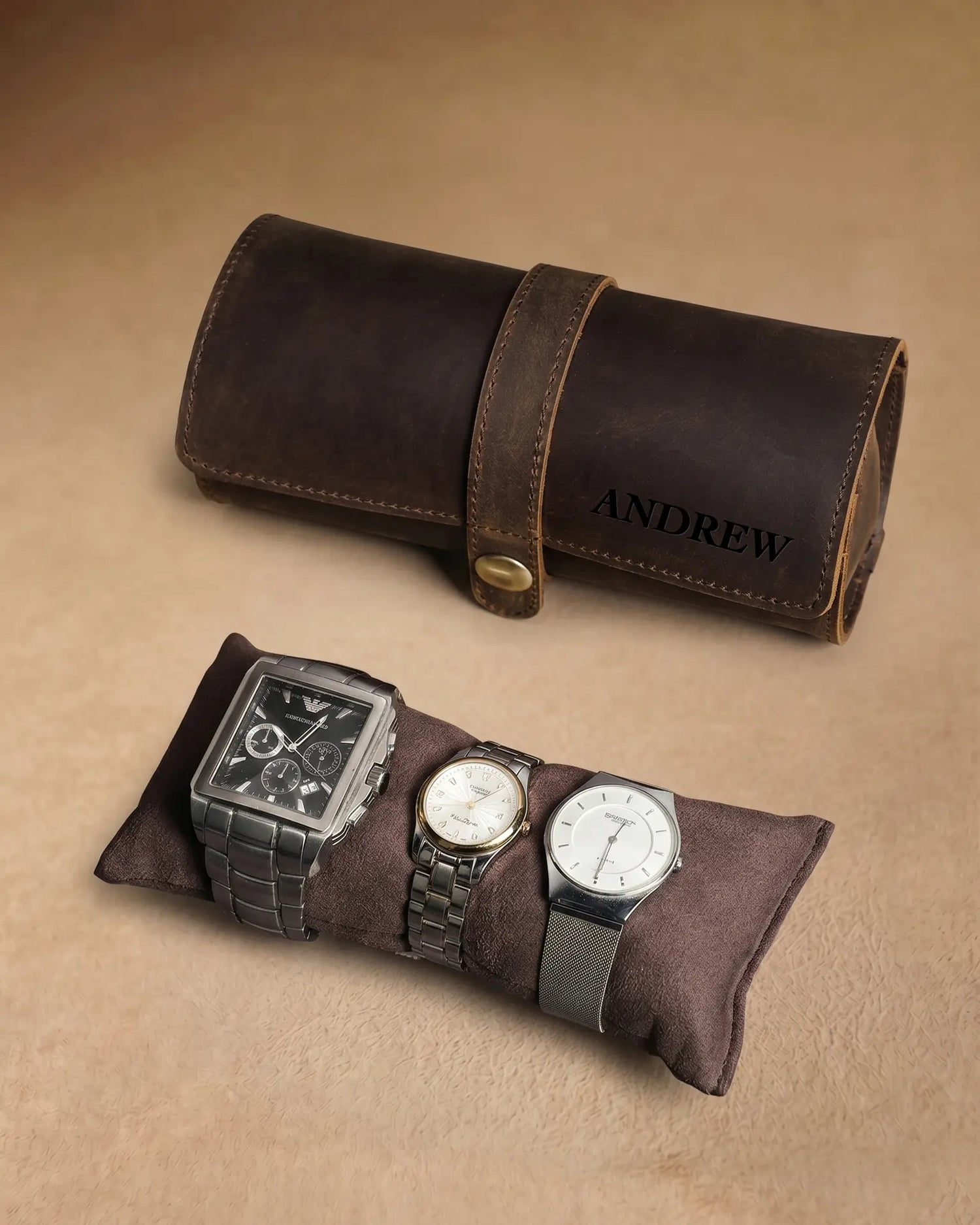
Journey Wrap 3本用レザーウォッチロール
Regular price
¥9,700 JPY
Regular price

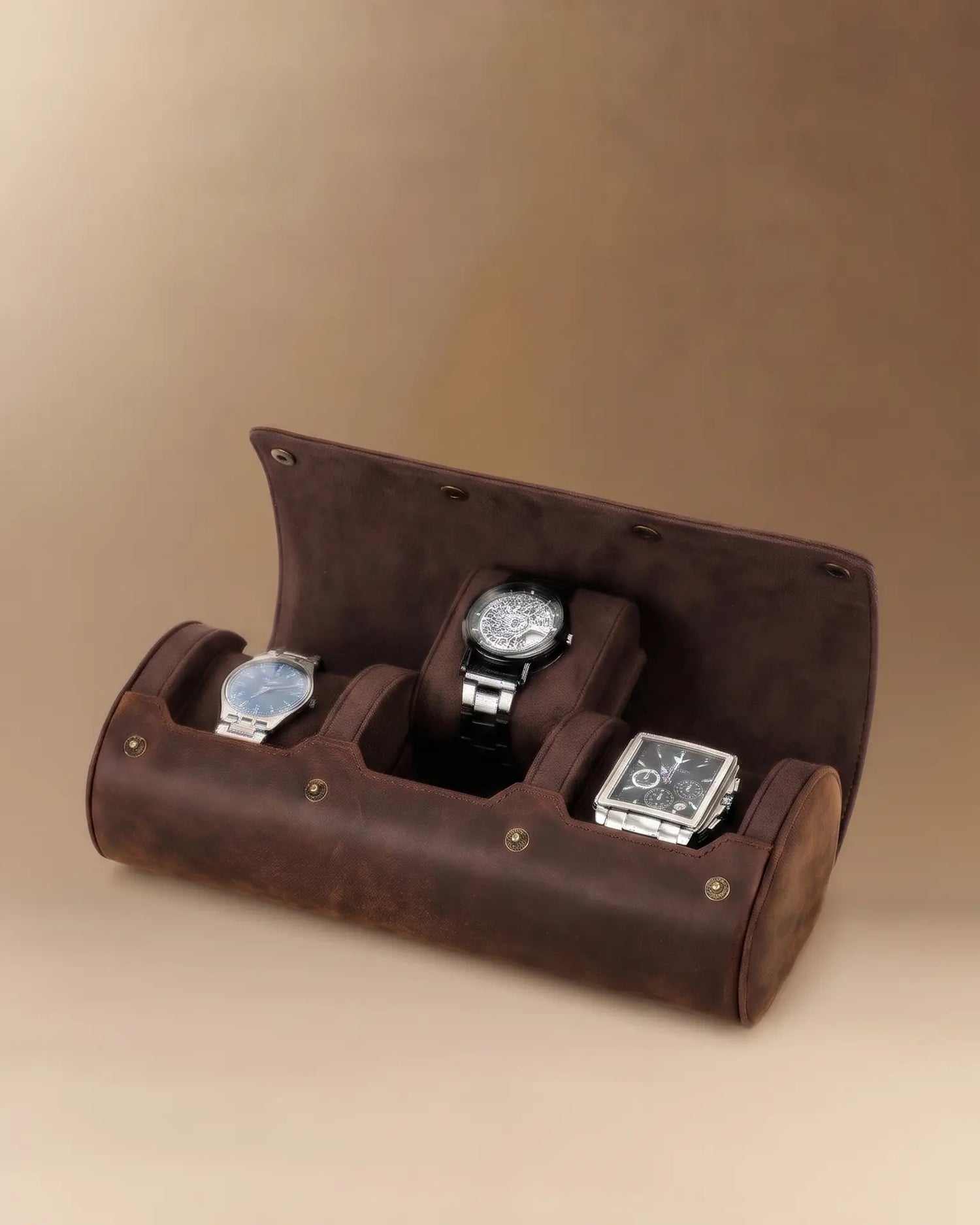
Legacy Rivet 3本用レザーウォッチロール
Regular price
¥19,100 JPY
Regular price
¥20,600 JPY
Sale price
¥19,100 JPY
Available in
 Dark Brown
 Dark Brown
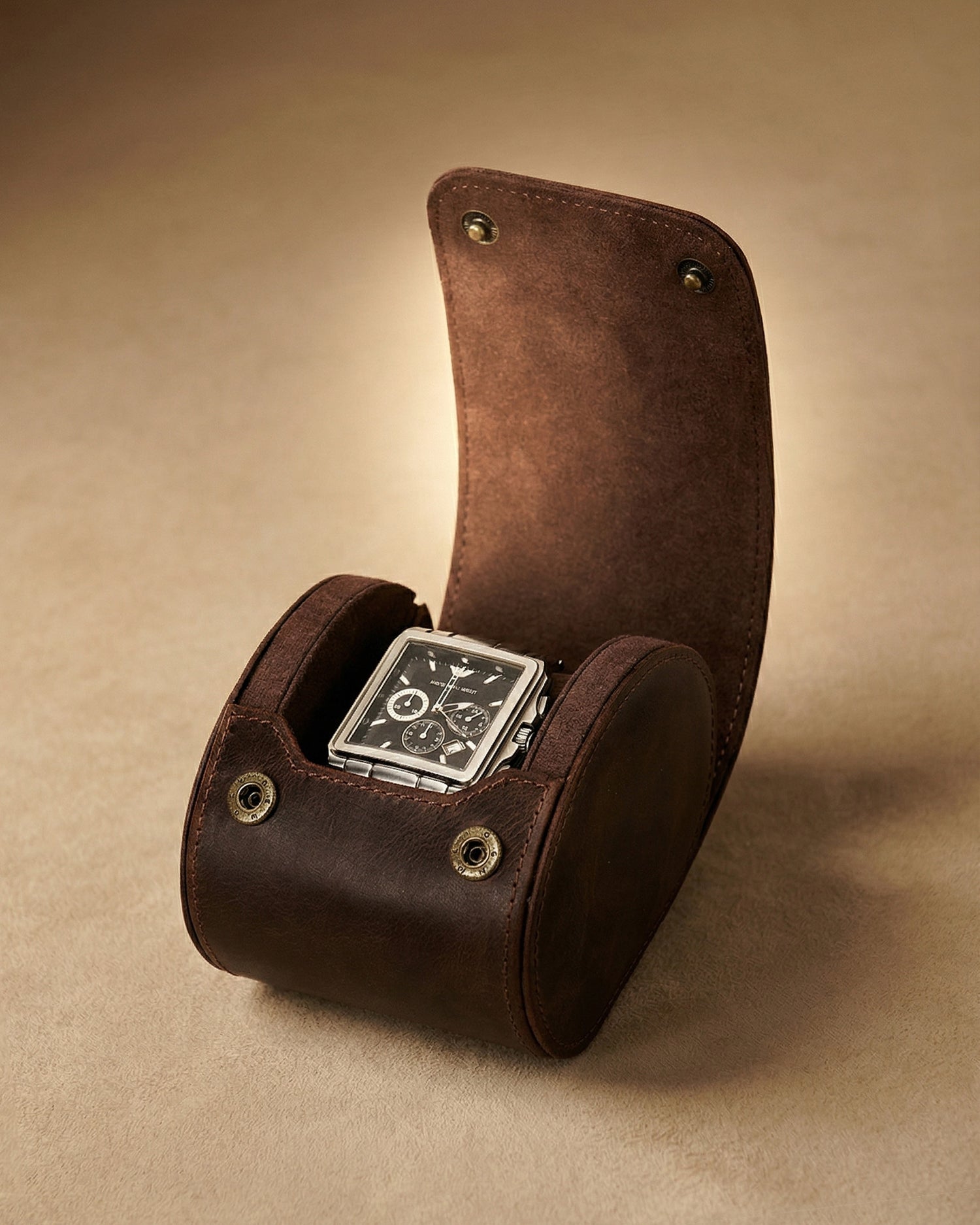
Legacy Rivet 1本用レザーウォッチロール
Regular price
¥12,700 JPY
Regular price
¥13,800 JPY
Sale price
¥12,700 JPY
Available in
Dark Brown
Dark Brown
Journey Wrap 2本用レザーウォッチロール
Regular price
¥8,000 JPY
Regular price
More Leather Guides
Explore practical guides to choosing, using and caring for leather goods.

Custom Leather Bookmark Guide: Thickness, Engraving and Magnet Options

Magnetic Bookmark With Pen Holder: Who It Is For and How to Use It
