
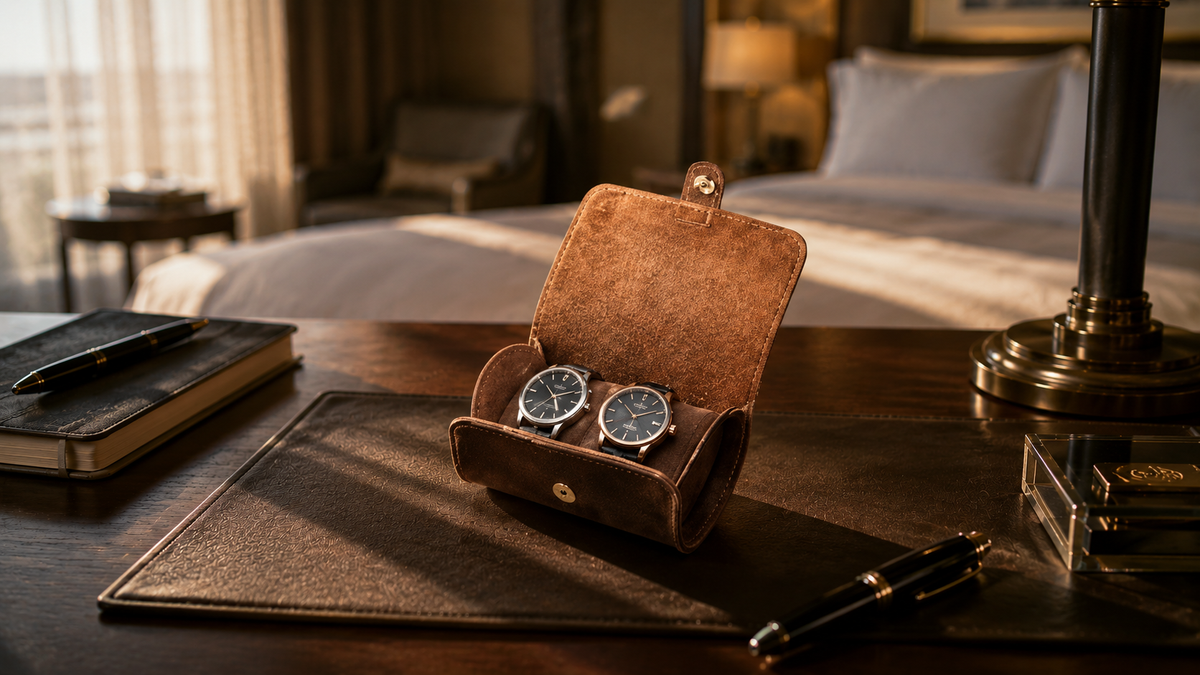
How to Pack Watches for Travel Without Scratches or Damage
Six travel cases ranked on published pocket count, pocket width and crush resistance, plus the packing method that prevents the damage no case can fix on its own. Leather grade came last.
By [BRAND] Editorial · Updated 25 August 2026 · Prices checked 25 August 2026 · ~4,000 words · 16 min read
|
HOW THIS GUIDE IS FUNDED [BRAND] sells watch travel cases. None of the six picks below are ours, because these six publish the pocket dimensions and capacity figures this comparison is built on, and we would rather rank on published numbers than on our own catalogue. No brand paid for placement. We name competitor products and compare them honestly, but we do not link to them.
|
Our Picks at a Glance
|
BEST OVERALL SEPARATION
 W.O.E. The Diplomat 4 Watch Roll
$155
|
BEST ON A BUDGET
 Crown & Buckle Canvas Watch Roll
$70
|
BEST CRUSH PROTECTION
 W.O.E. 6 Watch Storage & Travel Case
$82
|
Every pick in this guide, ranked by how completely it keeps one watch away from the next.
|
Pick
|
Separation method
|
Published fit
|
Packed size
|
Price
|
|
W.O.E. The Diplomat 4 Watch Roll
|
Four extra-deep sewn pockets plus a tool pocket
|
Watches up to 44 mm
|
Not published
|
$155
|
|
Crown & Buckle Canvas Watch Roll
|
Six sewn pockets, microsuede lined
|
Pockets 2.5 in (63.5 mm) wide
|
15.25 × 5.75 in unrolled
|
$70
|
|
Rickshaw Bagworks TimeKeeper 4
|
Four plush pockets, foam on both faces
|
Watches up to 45 mm
|
6.75 × 5.75 × 0.75 in
|
$90
|
|
Rickshaw Bagworks TimeKeeper 2
|
Two plush pockets loaded from opposite ends
|
Watches up to 45 mm
|
6.75 × 3 × 0.75 in
|
$60
|
|
W.O.E. Watch Tube, Tiger Stripe
|
Rigid tube, two watches
|
Not published
|
Not published
|
$78
|
|
W.O.E. 6 Watch Storage & Travel Case
|
Six precut foam spaces in a locking shell
|
Not published
|
11 × 9 × 4.5 in
|
$82
|
Three entries do not publish a figure this guide would like to have. The Diplomat does not print a packed size, the Watch Tube prints neither an interior dimension nor a case limit, and the hard case gives an exterior size but no per-slot diameter. Those gaps are marked "Not published" rather than estimated.
Which Travel Case Wins for Scratch Protection?
For most travelers carrying more than one watch, the W.O.E. Diplomat 4 Watch Roll ($155) is the right buy, because its four pockets are sewn deep enough to swallow a bracelet and clasp completely and it adds a separate pocket so a spring bar tool never rides beside a crystal. On a budget, the Crown & Buckle Canvas Watch Roll ($70) publishes a 2.5 in pocket width across six slots, which is the widest per-slot figure here. If the bag gets stacked, crushed or checked, the W.O.E. 6 Watch Storage & Travel Case ($82) puts six watches in precut foam behind a dual-locking shell.
Travel damage is rarely dramatic. It is a folded clasp resting against a caseback for a six-hour flight, and a ring of fine marks you only find under a lamp at the hotel.
The pocket is the problem, not the leather. A watch that cannot move cannot scratch, and movement is decided by whether each pocket is deep enough to contain a closed bracelet and narrow enough to hold it still. Everything else on a product page is finish.
Pick by need
|
You have
|
Buy this
|
Why
|
|
One spare watch on a light trip
|
A two-pocket padded case
|
Opposite-end loading keeps the crystals apart
|
|
Three or more watches on bracelets
|
A roll with individually sewn pockets
|
Shared compartments let bracelet edges reach the next case
|
|
A 44 mm diver plus a dress watch
|
A published per-pocket width
|
Wide cases jam narrow pockets and ride proud of the divider
|
|
Spare straps and a spring bar tool
|
A carrier with a separate tool pocket
|
Loose steel tools scratch more watches than luggage does
|
|
A checked bag or rough handling
|
A precut foam hard case
|
Fabric stops scratching and does nothing about pressure
|
|
A trip through crowded cities
|
The smallest case that fits the watches
|
Bulk is what makes a bag worth opening
|
How We Judged These Cases
Separation Whether every watch gets its own sewn pocket or foam cutout. A shared compartment with a soft divider scored below an individually sewn one.
Pocket geometry Published width and depth against a 40 to 45 mm case with a closed bracelet. A published number beat a claim about fitting most watches.
Crush behavior What happens when the case is loaded and pressure is applied from outside. Foam and rigid shells scored above canvas and leather.
Tool discipline Whether the design gives spring bar tools, spare buckles and links a home away from the watches.
This is a desk comparison built on manufacturer and authorized dealer specifications, with prices checked on 25 August 2026. Where a maker does not publish a figure, the card says "Not published" rather than guessing. Every card carries an evidence line naming its source.
What Counts as Real Separation
Separation is a spectrum, not a yes or no. InsideHook splits travel storage into pouches, tubes, rolls and cases, and those formats land at four different levels of separation. These are the four, worst to best.
|
Level
|
What it looks like
|
What still touches
|
Verdict
|
|
None
|
Two watches in one open pouch
|
Everything: bezels, clasps, crowns
|
Not travel storage
|
|
Soft divider
|
One compartment with a flap between watches
|
Cases tilt past the divider under pressure
|
Better than nothing
|
|
Sewn pockets
|
Each watch in its own stitched sleeve
|
Nothing, provided the pocket is deep enough
|
The working minimum
|
|
Precut foam
|
Each watch in a cut cavity in a rigid shell
|
Nothing, and pressure is absorbed too
|
Best available
|
Why a Watch Gets Marked Inside a Bag

Four ways a watch gets marked inside a bag. All mechanical, all preventable.
Clasp on caseback
A closed bracelet folds under the watch head and the clasp corner rests against the caseback. Six hours of small vibration puts a ring of fine marks on brushed or polished steel. This is the single most common travel scratch and it happens entirely inside a closed case.
Case-to-case contact
Two watches in one compartment find each other the moment the bag changes direction. Bezel edges and crown guards are hard and narrow, which is exactly the shape that cuts.
Loose rotation
A watch that can spin in an oversized pocket drags its bracelet across the lining and its crown against a seam. Nothing dramatic happens, and the lug edges dull anyway.
Crushing
A soft roll under a laptop transfers the load straight through the leather to the crystal and bezel. Fabric protects against abrasion, not pressure.
|
WATCH OUT Do not solve a loose pocket by stuffing tissue or a sock around the watch. That adds bulk against the crystal and crown, which is where you least want pressure. A loose pocket needs a smaller pocket or a proper cushion, not packing material.
|
Best Multi-Watch Carriers, Three or More Slots
Individually sewn pockets are the mechanism that makes a roll worth carrying. All three below publish either a pocket dimension or a case limit, and all three keep every watch in a compartment of its own. One is hand-sewn in the USA at $155, one costs $70, and one zips flat enough to slide beside a laptop.
BEST OVERALL SEPARATION
1. W.O.E. The Diplomat 4 Watch Roll
Four extra-deep pockets, a fifth pocket for a strap or

spring bar tool, and waxed ripstop canvas that takes a scuff instead of showing one. The depth is the point. A closed steel bracelet disappears into the pocket rather than folding back against the caseback, which is where most travel marks start.
|
Exterior
|
American-made waxed ripstop canvas with leather trim
|
|
Lining
|
Suede
|
|
Separation
|
Four extra-deep sewn pockets plus one accessory pocket
|
|
Fit
|
Watches up to 44 mm
|
|
Closure
|
Leather strap with steel D-ring
|
|
Packed size
|
Not published
|
|
Made in
|
United States, hand-sewn
|
WHAT WORKS
✓ Extra-deep pockets contain the bracelet and clasp rather than folding them
✓ Separate accessory pocket keeps a spring bar tool away from the crystals
✓ Waxed canvas and leather patina instead of marking
✓ D-ring strap stays shut under luggage compression
WHAT TO WEIGH
– No published packed size, so cabin bag fit has to be estimated
– 44 mm limit rules out the largest divers
– Hand-sewn, so the maker warns of minor variation between units
– Most expensive soft carrier here
Best for: Three or four watches on bracelets, carried in a personal item on regular trips.
$155 Price checked 25 August 2026 Named, not linked
Evidence: Manufacturer specifications; capacity cross-checked against InsideHook hands-on coverage.
BEST ON A BUDGET
2. Crown & Buckle Canvas Watch Roll
Six pockets at $70, and the only pick in this guide that prints an actual pocket width. Each sleeve measures 2.5 in across, which is generous enough for a 44 mm diver on a bracelet and still snug on a 36 mm dress watch. Nylon canvas outside, microsuede inside, hook-and-loop closure.
|
Exterior
|
Nylon canvas, tone-on-tone stitching
|
|
Lining
|
Microsuede
|
|
Separation
|
Six individually sewn pockets
|
|
Fit
|
Pockets 2.5 in (63.5 mm) wide
|
|
Unrolled size
|
15.25 × 5.75 in
|
|
Closure
|
Hook-and-loop strap
|
|
SKU
|
SR-304
|
WHAT WORKS
✓ Published pocket width, which almost nothing else in this category gives you
✓ Six slots at a price most makers charge for two
✓ Microsuede lining is soft enough for polished cases
✓ Hook-and-loop opens one-handed on a hotel desk
WHAT TO WEIGH
– Longest item here unrolled at 15.25 in
– Canvas gives no crush resistance at all
– Hook-and-loop collects lint and weakens over years
– Six loaded slots make a bulky roll
Best for: A first roll, a large rotation, or anyone who wants the pocket width in writing.
$70 Price checked 25 August 2026 Named, not linked
Evidence: Manufacturer specifications and product page listing, checked 25 August 2026.
BEST FLAT PACKING
3. Rickshaw Bagworks TimeKeeper 4

Not a roll. A flat zip case with four plush-lined pockets and closed-cell foam laminated to both outer faces, which is a different answer to the same question. At 0.75 in thick it slides into a laptop sleeve, and the foam means a stacked bag presses on padding rather than on a bezel.
|
Exterior
|
Ultragrid nylon with closed-cell foam padding
|
|
Lining
|
Royal Plush
|
|
Separation
|
Four sewn pockets
|
|
Fit
|
Watches up to 45 mm
|
|
Exterior size
|
6.75 × 5.75 × 0.75 in
|
|
Interior size
|
6.0 × 5 in
|
|
Closure
|
YKK #5 zipper with paracord pull
|
WHAT WORKS
✓ Foam on both faces, so it resists pressure as well as abrasion
✓ 0.75 in thick, which fits where a rolled case will not
✓ Zipper cannot work loose the way a strap or cord can
✓ Published interior and exterior dimensions
WHAT TO WEIGH
– Zip teeth run close to the opening, so load dial-inward
– Nylon reads as equipment rather than an accessory
– No accessory pocket for tools or spare straps
– Four slots is the ceiling
Best for: Business travel where the watch case shares a bag with a laptop.
$90 Price checked 25 August 2026 Named, not linked
Evidence: Manufacturer specifications via authorized dealer listing, checked 25 August 2026.
|
VERDICT The Diplomat wins this group on pocket depth, which is the spec that actually stops a clasp meeting a caseback, and on the accessory pocket that keeps tools out of the watch compartment. Take the Crown & Buckle if six slots at $70 matters more than crush resistance, and take the TimeKeeper 4 if the case has to travel flat beside a laptop.
|
Best Two-Watch Cases for the Wear-One-Pack-One Trip
Most trips need exactly two watches, and a two-slot case is smaller, cheaper and easier to keep on your person than a roll with empty pockets. These two solve it in opposite ways: one flat and padded, one rigid and cylindrical.
BEST FOR TWO WATCHES
4. Rickshaw Bagworks TimeKeeper 2
Two pockets, and a design detail worth more than it sounds: you load the watches from opposite ends so the crystals never face each other. Same Royal Plush lining and twin-face foam as its larger sibling, in a case slim enough for a jacket pocket.
|
Exterior
|
Ultragrid nylon with closed-cell foam padding
|
|
Lining
|
Royal Plush
|
|
Separation
|
Two sewn pockets, opposite-end loading
|
|
Fit
|
Watches up to 45 mm
|
|
Exterior size
|
6.75 × 3 × 0.75 in
|
|
Interior size
|
6.0 × 2.5 in
|
|
Closure
|
YKK #5 zipper with paracord pull
|
WHAT WORKS
✓ Opposite-end loading puts a caseback, not a crystal, against the divider
✓ Foam on both faces at $60
✓ Slim enough to carry on your person through a busy terminal
✓ Made in San Francisco, with dimensions published inside and out
WHAT TO WEIGH
– Two watches only
– No room for a spare strap
– Nylon exterior will not develop character the way leather does
– Zip hardware sits near the watch when packed carelessly
Best for: The wear-one-pack-one trip, which is most trips.
$60 Price checked 25 August 2026 Named, not linked
Evidence: Manufacturer specifications via authorized dealer listing, checked 25 August 2026.
BEST POCKETABLE RIGIDITY
5. W.O.E. Watch Tube, Tiger Stripe

A rigid tube for two watches, built to go in a jacket or a front jean pocket rather than a bag. The shape is the argument: a cylinder resists crushing from every direction, where a flat case only resists it from two. What it will not tell you is how big a watch fits.
|
Format
|
Rigid two-watch tube
|
|
Separation
|
Two positions within the tube
|
|
Fit
|
Not published
|
|
Interior dimensions
|
Not published
|
|
Packed size
|
Not published
|
|
Closure
|
Not published
|
|
Intended use
|
Travel and home storage
|
WHAT WORKS
✓ Cylindrical shell resists pressure from any angle
✓ Small enough to keep on your person rather than in a bag
✓ Rigid format at well under hard-case money
WHAT TO WEIGH
– No published case limit, so confirm with the brand before buying for a large diver
– No published interior or exterior dimensions
– Two watches only
– Costs more than the flat two-watch case that does publish its numbers
Best for: Carrying two watches on your person through a city you do not know well.
$78 Price checked 25 August 2026 Named, not linked
Evidence: Manufacturer product listing. Dimensional specifications are not published at the time of writing.
|
VERDICT The TimeKeeper 2 takes this group, and it is not close on published information. It costs less, prints its interior and exterior dimensions, states a 45 mm limit and pads both faces. The Watch Tube earns its place on shape alone, because a rigid cylinder in a pocket is a genuinely different kind of protection, but you are buying it without knowing what fits inside.
|
Best Hard Case When the Bag Gets Rough
Soft carriers handle abrasion. Nothing soft handles a suitcase being stacked under three others. Precut foam inside a locking shell is the only format in this comparison that isolates a watch from outside pressure, and one pick here does it.
BEST CRUSH PROTECTION
6. W.O.E. 6 Watch Storage & Travel Case
Six precut foam cavities inside a dual-locking shell rated to keep water and dust out. The maker describes it plainly as a tool rather than a luxury item, and that is the right framing. It is the pick for a checked bag, a rental car trunk or a safe, and it is the wrong pick for a slim carry-on.
|
Format
|
Rigid locking case with precut foam insert
|
|
Separation
|
Six individual precut foam spaces
|
|
Fit
|
Not published
|
|
Exterior size
|
11 × 9 × 4.5 in (28 × 22.9 × 11.43 cm)
|
|
Closure
|
Dual-locking system, two locking points
|
|
Sealing
|
Rated against dust and moisture
|
|
Colors
|
Black, olive drab, yellow
|
WHAT WORKS
✓ Precut foam is the only separation method here that also absorbs pressure
✓ Two locking points, so the lid will not spring in transit
✓ Sealed against dust and moisture
✓ Unassuming exterior, which matters more than it should
WHAT TO WEIGH
– No published per-cavity diameter, so a 44 mm diver is an unknown
– 11 × 9 × 4.5 in eats most of a personal item
– Imported, unlike the maker's hand-sewn USA rolls
– Overkill for one spare watch
Best for: Six watches moving by car, or one collection that has to survive a checked bag.
$82 Price checked 25 August 2026 Named, not linked
Evidence: Manufacturer specifications and product page, checked 25 August 2026.
|
VERDICT Buy this when pressure is the risk rather than abrasion, and accept the bulk as the cost of that. At $82 for six sealed foam cavities it undercuts most soft rolls holding the same number of watches. The gap is the missing per-cavity diameter, so confirm before committing a large diver to it.
|
Fit Check: The Two Minutes That Prevent a Return

Fit is the weakest part of almost every packing guide. A case can use excellent materials and still be the wrong purchase because the pocket is too shallow for your bracelet. Measure your own watches before you buy anything. If you are buying for a single spare watch, a pouch sized to hold one watch without letting it slide removes most of these measurements from the decision.
-
Close the bracelet or buckle the strap the way you actually wear it. No adjusting for the test.
-
Lay the closed loop flat and measure its length end to end, then its widest point across the case.
-
Measure case thickness at the tallest point, crystal included. Domed crystals and dive bezels are what run out of clearance first.
-
Repeat for every watch you plan to pack. Your largest measurement sets the requirement, not the average.
-
Compare against the published pocket width and interior depth. If the maker publishes nothing, treat that as information.
-
Load the case, close it, then tilt it slowly in four directions. Movement you can hear or feel means the pocket is wrong for that watch.
|
Measure
|
Take it from
|
Compare against
|
|
Case diameter
|
Widest watch, crown included
|
Published pocket width
|
|
Case thickness
|
Tallest watch on its cushion
|
Interior depth or lid clearance
|
|
Closed bracelet length
|
The longest bracelet you own
|
Pocket depth, not pocket width
|
|
Number of watches
|
The trip, not the collection
|
Slot count, minus the one on your wrist
|
|
Case exterior
|
Not applicable
|
The bag you actually travel with
|
|
TIP Keep the largest number in a note on your phone. Ours is 45 mm across and 14.2 mm tall, off a dive watch on a steel bracelet. It has ruled out more cases than any other spec.
|
Protection Features That Matter More Than Material
Materials decide how the case looks in year five. Structure decides what happens when a suitcase gets stacked. Different questions, and buyers routinely answer the wrong one.
|
Feature
|
What it actually does
|
What to check
|
|
Pocket depth
|
Contains the bracelet so the clasp cannot fold onto the caseback
|
Does a closed bracelet sit fully inside
|
|
Pocket width
|
Stops the watch rotating
|
Published figure against your widest case
|
|
Foam or rigid shell
|
Absorbs pressure from outside the case
|
Press the wall. It should not fold
|
|
Lining pile
|
Keeps seams and hardware off the crystal
|
Feel the pocket corners, not the flat
|
|
Closure
|
Keeps the case shut under compression
|
Test it loaded, never empty
|
|
Accessory pocket
|
Keeps tools and buckles away from watches
|
Is it separate, or just another slot
|
Which Materials Travel Best
Material claims on a product page are regulated language, and the gap between "leather" and "leather-look" is a legal one rather than a matter of taste. If a listing says leather with no qualifier and the price looks impossible, read the material line again.
Waxed canvas and nylon behave better in transit than most buyers expect. Both take a scuff without showing it, both dry out after a wet taxi rank, and neither cracks at the fold the way a coated finish does. Two of the six picks here are canvas or nylon and both sit in the upper half of the ranking.
Leather earns its place on the exterior, not the interior. Inside, what matters is pile depth and how the lining is bonded at the seams, because a seam that stands proud is the thing that meets a crystal. Microsuede, plush and suede all work. A thin lining glued over a hard edge does not.
Foam is the material nobody reads about and everybody relies on. Closed-cell foam laminated to a case face resists compression and recovers; open-cell padding feels softer in the shop and gives up sooner. Precut foam inserts sit at the top of this hierarchy because they hold shape and absorb load at the same time.
What You Should Expect to Pay
|
Tier
|
Typical price
|
What you get
|
Watch out for
|
|
Entry
|
Under $50
|
Two-slot pouches, coated finishes, basic linings
|
Coating cracks at folds; no published dimensions
|
|
Mid
|
$50 to $100
|
Sewn pockets, foam faces, canvas or nylon, hard shells at the top
|
Capacity marketed above separation
|
|
Upper mid
|
$100 to $200
|
Hand-sewn rolls, deep pockets, accessory pockets, USA manufacture
|
Paying for provenance rather than protection
|
|
Premium
|
$200 plus
|
Structured holders, sized cushions, bespoke fitting
|
Branding priced above function
|
A $155 roll does not automatically protect better than a $70 one. In this guide the $70 Crown & Buckle publishes a wider pocket than anything else here, and the $82 hard case out-protects every soft carrier in the comparison. Measurements decide protection. Price decides finish.
Watch Roll vs Padded Zip Case vs Hard Case
|
|
Watch roll
|
Padded zip case
|
Hard case
|
|
Typical capacity
|
3 to 6
|
2 to 4
|
6 to 18
|
|
Packed size
|
Bulky when loaded
|
Smallest
|
Largest
|
|
Crush resistance
|
Low
|
Medium
|
Highest
|
|
Abrasion protection
|
High, if pockets are sewn
|
High
|
Highest
|
|
Best environment
|
Carry-on, between clothing
|
Beside a laptop
|
Checked bags, car, safe
|
|
Weak point
|
Pressure from outside
|
Zip hardware near the watch
|
Bulk and attention
|
How to Choose in Seven Steps
-
Measure your widest and tallest watch. That number, not the brand, is the brief.
-
Count the watches the trip needs, then subtract the one on your wrist.
-
Filter to cases that publish a pocket width or a case limit. Silence is an answer.
-
Match structure to the bag. Soft between clothing, foam-faced beside a laptop, rigid for a checked bag.
-
Check that every watch gets its own sewn pocket or foam cavity. Shared compartments are not separation.
-
Look for a separate home for tools and spare straps before you look at the exterior material.
-
Set the budget against those functions, then let color and brand break the tie.
How to Pack a Case for a Trip
Carry-on, always. The Transportation Security Administration advises keeping valuable jewelry with you instead of in checked baggage, and you can ask an officer for private screening if opening a watch case in front of a queue does not appeal. Crossing a border with several watches is a separate risk: the writer at Fratello was stopped at Basel and paid several thousand Swiss francs for lack of paperwork, so carry receipts and keep the expensive one on your wrist.
-
Wipe each watch dry before it goes in. Grit between two metal surfaces on a long flight behaves like sandpaper.
-
Fasten each bracelet around its cushion or into its pocket before the next watch goes in. Less reaching over crystals.
-
Load a two-slot case from opposite ends so a caseback, not a crystal, faces the divider.
-
Bed a soft roll between clothing, away from shoes, chargers and toiletry bags.
-
Keep the case reachable, not buried. Security procedures vary and an officer may ask you to open it.
-
Tilt the loaded case before the bag shuts. Thirty seconds beats a hairline you find three days later.
|
WATCH OUT If you are traveling without a case at all, the sock method that Gear Patrol has recommended for years works as a one-trip fix: roll one clean sock, close the bracelet around it, keep fabric between clasp and caseback, then slide the whole thing into a second sock. It stops scratches. It does nothing about a compressed suitcase.
|
Looking After a Travel Case
A case that is looked after keeps its shape, and shape is what holds a watch still.
-
Wipe canvas and leather exteriors with a dry cloth. Water and finished leather are a poor combination.
-
Brush suede, microsuede and plush linings rather than cleaning them. Dust collects in the pocket corners first.
-
Store a roll unrolled at home so the leather or canvas is not held in a compressed shape for months.
-
Rotate which pocket each watch uses. A pocket that carries the same heavy diver every trip stretches unevenly.
-
Let a damp case dry fully open before it goes back in a drawer.
-
Keep it out of direct sun. Fading shows fastest on tan and olive.
Six Mistakes We See Most Often
-
Treating capacity as separation. A pouch that fits three watches is not a three-watch case unless they cannot reach each other.
-
Buying for the largest watch in the rotation, then watching a 36 mm dress piece rotate in the same pocket.
-
Packing a spring bar tool beside the watches because it is small. It is small and hard, which is the worst combination.
-
Solving a loose pocket with tissue or fabric, which puts pressure on the crystal and crown.
-
Trusting a soft roll to survive a checked bag. Fabric handles abrasion, not compression.
-
Ignoring a missing spec. A maker that will not publish a pocket dimension has told you something.
Glossary: What the Spec Sheet Means
|
Term
|
What it means
|
|
Sewn pocket
|
An individually stitched sleeve holding one watch. The working minimum for separation.
|
|
Precut foam
|
A rigid foam insert with cavities cut to watch shape. Separates and absorbs pressure.
|
|
Closed-cell foam
|
Padding that resists compression and recovers, usually laminated to a case face.
|
|
Deployant clasp
|
A folding bracelet clasp. The corner that meets a caseback when a bracelet folds.
|
|
Opposite-end loading
|
Placing two watches head to tail so crystals never face each other.
|
|
Crush resistance
|
Whether a case protects its contents from pressure applied from outside.
|
|
Accessory pocket
|
A separate compartment for tools, buckles and spare straps.
|
|
Water resistance rating
|
The pressure a watch was tested to when new. It ages with the gaskets.
|
Key Takeaways
-
Separation, not material, is what stops travel scratches. Every watch needs its own pocket or cavity.
-
Only two picks here publish a usable dimension: Crown & Buckle at 2.5 in pocket width, and both Rickshaw cases at 45 mm.
-
Pocket depth is the spec nobody prints and everybody needs, because it decides whether a clasp can reach a caseback.
-
Soft carriers handle abrasion. Only precut foam in a rigid shell handles pressure.
-
Price does not predict protection. The $70 pick publishes a wider pocket than the $155 one.
Final Word: Pockets First, Leather Last
The best travel case is the one where every watch sits in its own pocket, deep enough that the bracelet cannot fold back onto the caseback, and snug enough that nothing turns. Not the most expensive one, and not the one with the most recognizable name on the closure.
Measure your widest and tallest watch. Filter on published numbers and treat silence as information. Then pack it in your carry-on, keep the tools somewhere else, and tilt the closed case before the bag shuts.
Individually sewn pockets, published interior dimensions and a separate tool compartment. Full specifications sit on the travel cases built to stop watches moving collection page, with prices checked 25 August 2026.
Frequently Asked Questions
How Do You Carry Watches While Traveling?
Wear one and pack the rest in a case where every watch has its own sewn pocket, kept in your carry-on or personal item rather than a checked bag. The TSA advises keeping valuable jewelry with you instead of checking it, and private screening is available if you would rather not open a watch case in front of a queue. A zipped interior compartment also stops the case falling out the first time you reach for a passport. Two watches is the number most trips actually need.
Practical tip: close the case, move it gently, and listen. Anything you can hear will keep moving for the whole journey.
How Do You Pack a Wrist Watch?
Close the bracelet around a cushion the way it closes on your wrist, position the clasp so it cannot touch the caseback, then seat it in a pocket deep enough to contain the whole loop. Metal bracelets need the most attention underneath, because clasp corners and link ends cause the marks you notice later. Leather and rubber straps should not be folded sharply to fit a small pocket. Check that the crystal and crown have clearance before the lid closes, and never force a case shut.
Practical tip: close it once, reopen it, and confirm the watch, clasp and cushion all stayed where you put them.
Can I Pack a Watch in My Suitcase?
Yes, but the type of suitcase decides the answer. A carry-on is fine. A checked bag is a poor home for anything expensive or hard to replace, because it gets compressed, delayed and occasionally misrouted, all outside your control. If a watch has to travel in a checked bag, a rigid case with precut foam is the only format that meaningfully protects against the pressure involved. Inside a carry-on, keep the case away from shoes, chargers, laptops and toiletry bottles.
Practical tip: place the case in a zipped interior compartment surrounded by clothing, not at the outer edge where impacts land first.
How Do You Store a Watch When Traveling?
Keep it in its case, in the same spot, every day of the trip. A watch left loose on a hotel desk or bathroom counter invites both scratches and forgetfulness. In-room safes add a barrier against casual access, though staff can open them, so treat a safe as a deterrent rather than a guarantee. Store the watch dry and away from steam, direct sun and anything that runs hot. Hotel safes often sit on the minibar and run warm, which is worth knowing before you leave a watch in one for a week.
Practical tip: make one checkout sweep covering wrist, case, safe, bedside table and charging corner.
What Is the Best Way to Pack a Watch for Travel?
Correct pocket, no movement, carry-on. In that order. Secure the watch so the clasp cannot reach the caseback, place it where it cannot rotate or slide, and keep it with you rather than in the hold. One spare watch is well served by a padded two-slot case. Three or more need individually sewn pockets. Rigid cases with precut foam earn their bulk only when crushing or impact is a genuine risk rather than a theoretical one.
Practical tip: match the format to the risk. Soft between clothing, foam-faced beside a laptop, rigid for a checked bag.
What Is the 3 Watch Rule?
It is a collector convention, not a regulation, and no airline, customs authority or watch brand enforces anything of the kind. The idea is that a small collection covering three roles handles most situations: an everyday watch, a dress watch, and a sport or tool watch. It shaped the storage market, which is why so many travel rolls ship with three or four slots. Nothing about it obliges you to pack three watches, and most travel writing on the subject argues for fewer.
Practical tip: start with one versatile watch and add a second only when the itinerary clearly calls for it.
Do I Need to Declare My Rolex When Traveling?
Not automatically. It depends on where you acquired the watch, not what it cost. A watch you owned before leaving the United States is personal property, while U.S. Customs and Border Protection requires you to declare merchandise acquired abroad when you return. For an expensive foreign-made watch you already own, CBP Form 4457 records prior possession before departure, which removes the guesswork on the way back. It is voluntary and free. Rules outside the United States vary, so check every authority on your route.
Practical tip: keep receipts, insurance schedules or a stamped 4457 accessible, not buried in a checked bag.
Is It Okay to Keep My Rolex in a Box for a Year?
Yes. An automatic that stops is not an automatic that is damaged. Rolex notes that a watch set aside holds its charge for two days or more depending on the model, then stops, which is normal behavior rather than neglect. Before wearing it again, wind it by hand: unscrew the crown fully, turn it clockwise at least 25 times, then screw it back down against the case so waterproofness is preserved. Store it clean and dry at a stable indoor temperature with the crown secured.
Practical tip: after long storage, follow the winding and setting instructions for your specific model before setting the time.
Sources
- Transportation Security Administration. Jewelry: What Can I Bring?. Carry-on guidance for valuables and the availability of private screening, used in the packing section.
- U.S. Customs and Border Protection. What to Expect When You Return. Declaration of merchandise acquired abroad and the treatment of personal effects, used in the customs FAQ.
- U.S. Customs and Border Protection. Form 4457, Certificate of Registration for Personal Effects Taken Abroad. The voluntary registration route for valuable foreign-made items before departure.
- Rolex. Caring for Your Rolex. Manual winding procedure, minimum 25 crown turns and power reserve after a watch is set aside.
- Gear Patrol. How to Pack and Travel with Your Watches. Zen Love, January 2023. Trip-based watch selection, rolls and cases, and the improvised sock method used in the packing section.
- Fratello. How To Travel With Your Watches Like A Pro. June 2023. Collector account of border checks, vintage watch failures in humidity, and the case for packing light.
- InsideHook. A Guide to Watch Storage and Travel. Oren Hartov, December 2025. Format definitions for pouches, tubes, rolls, cases, boxes and winders, and capacity detail on two picks in this guide.





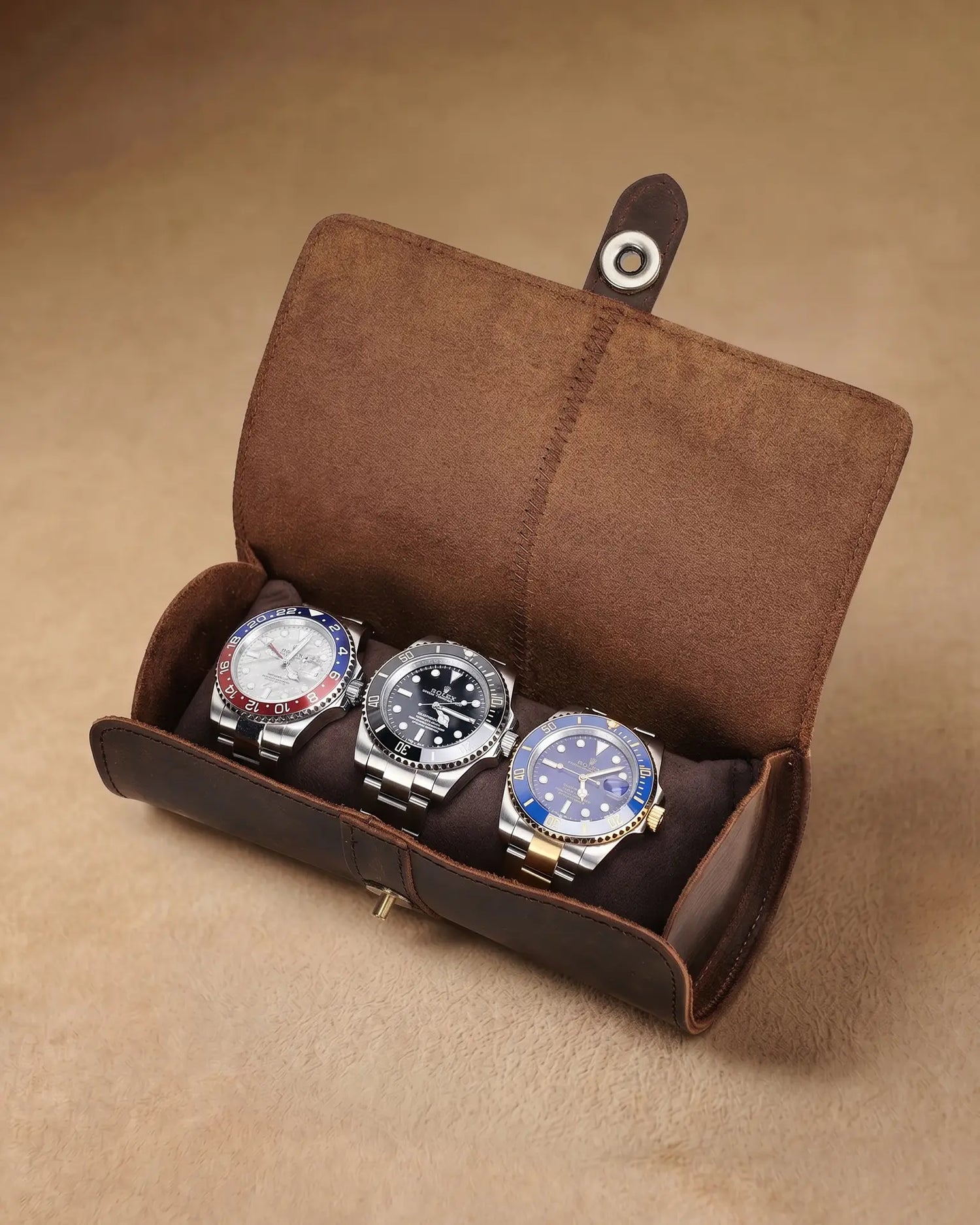
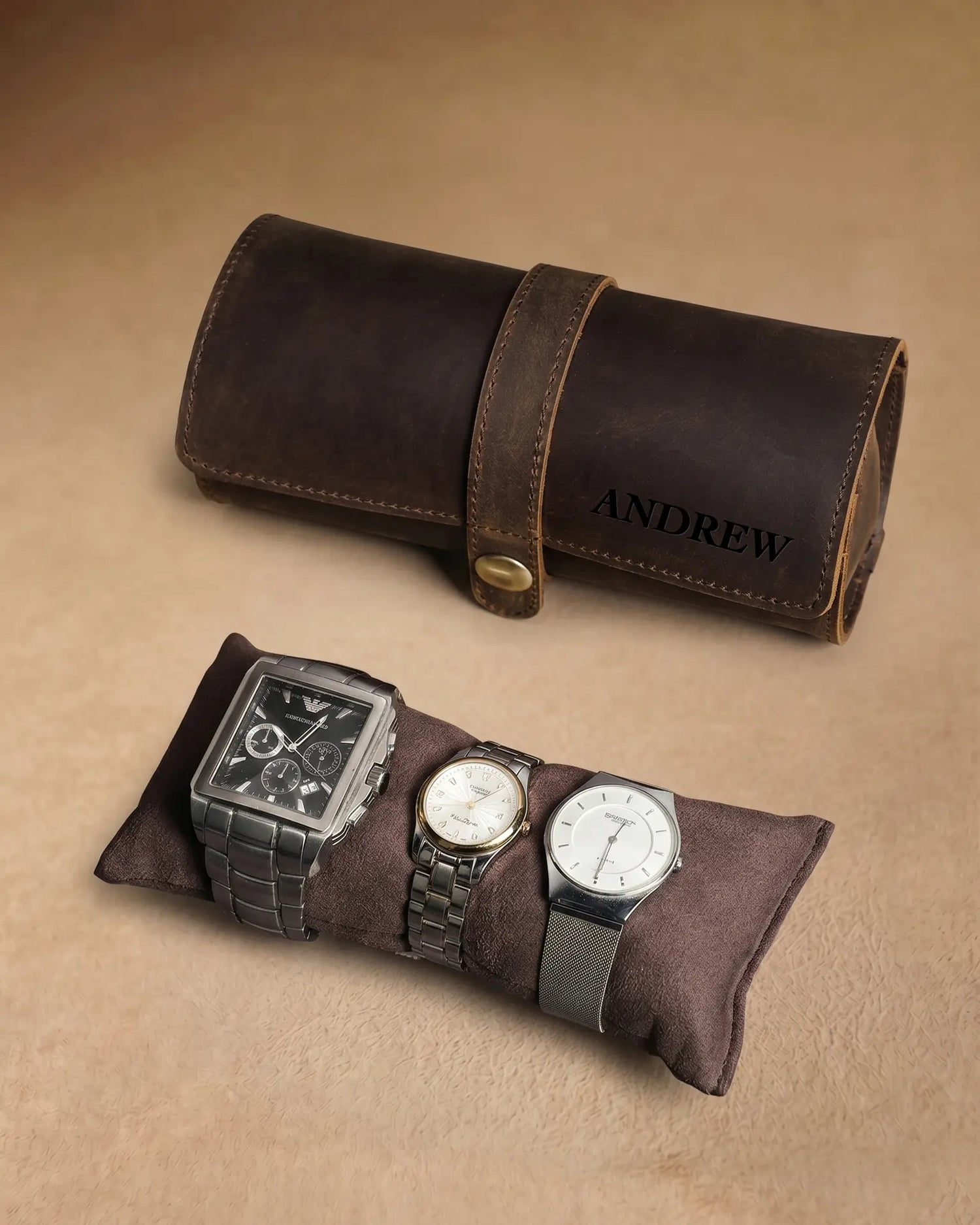

Journey Wrap Triple Watch Roll
Regular price
$59.95 USD
Regular price
Legacy Rivet Triple Watch Roll
Regular price
$119.00 USD
Regular price
$128.00 USD
Sale price
$119.00 USD
Available in
 Dark Brown
 Dark Brown
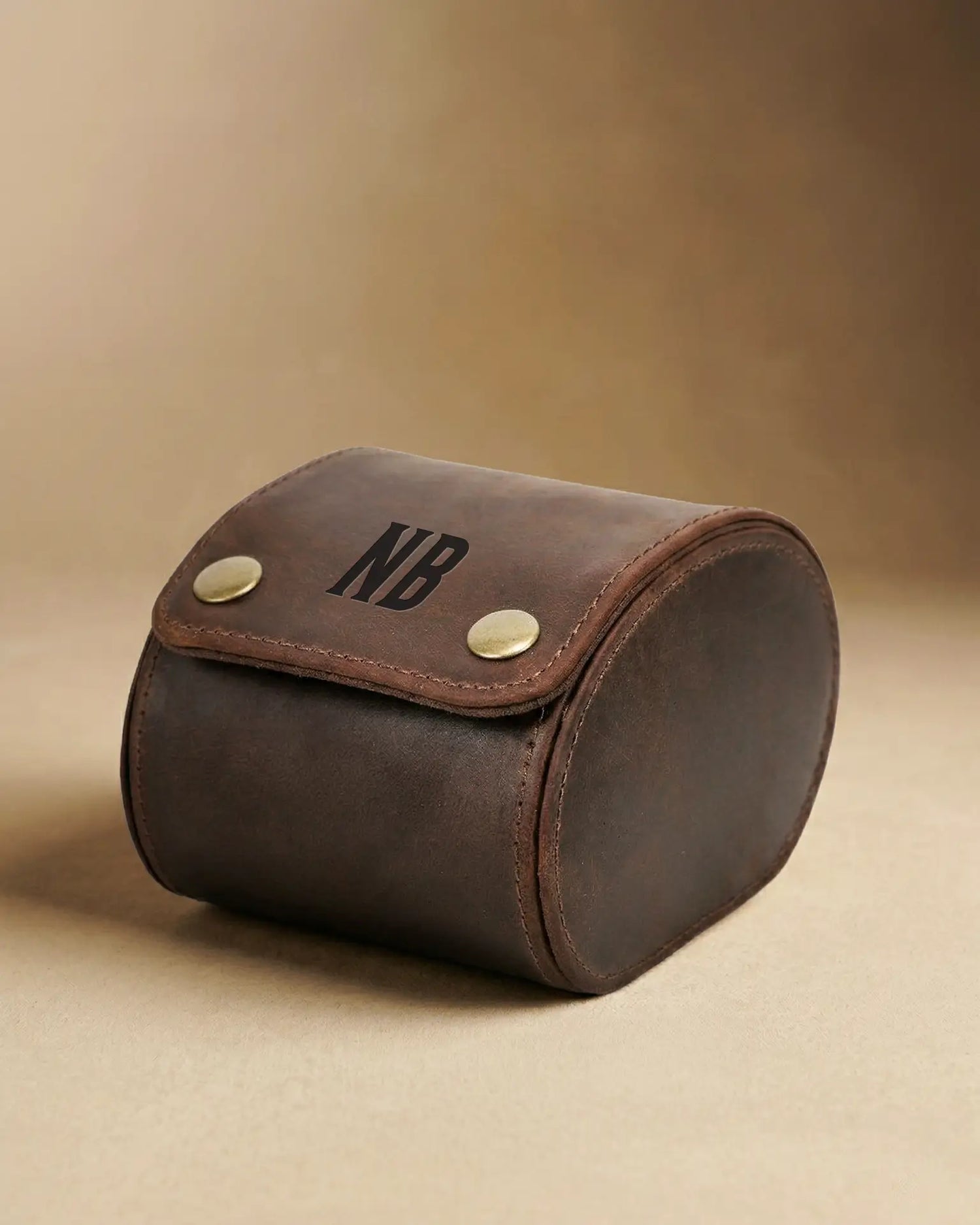
Legacy Rivet Single Watch Roll
Regular price
$79.00 USD
Regular price
$86.00 USD
Sale price
$79.00 USD
Available in
Dark Brown
Dark Brown
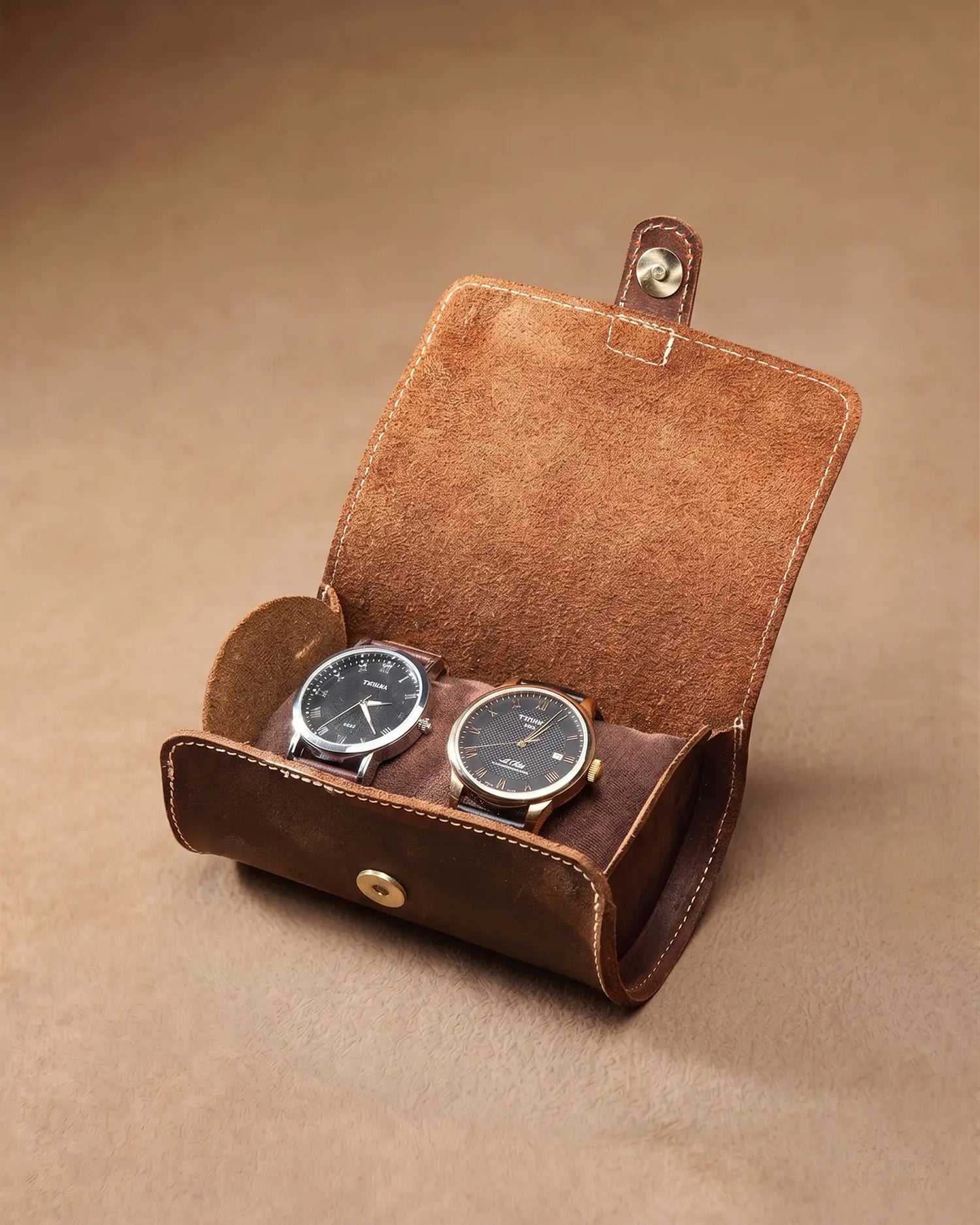
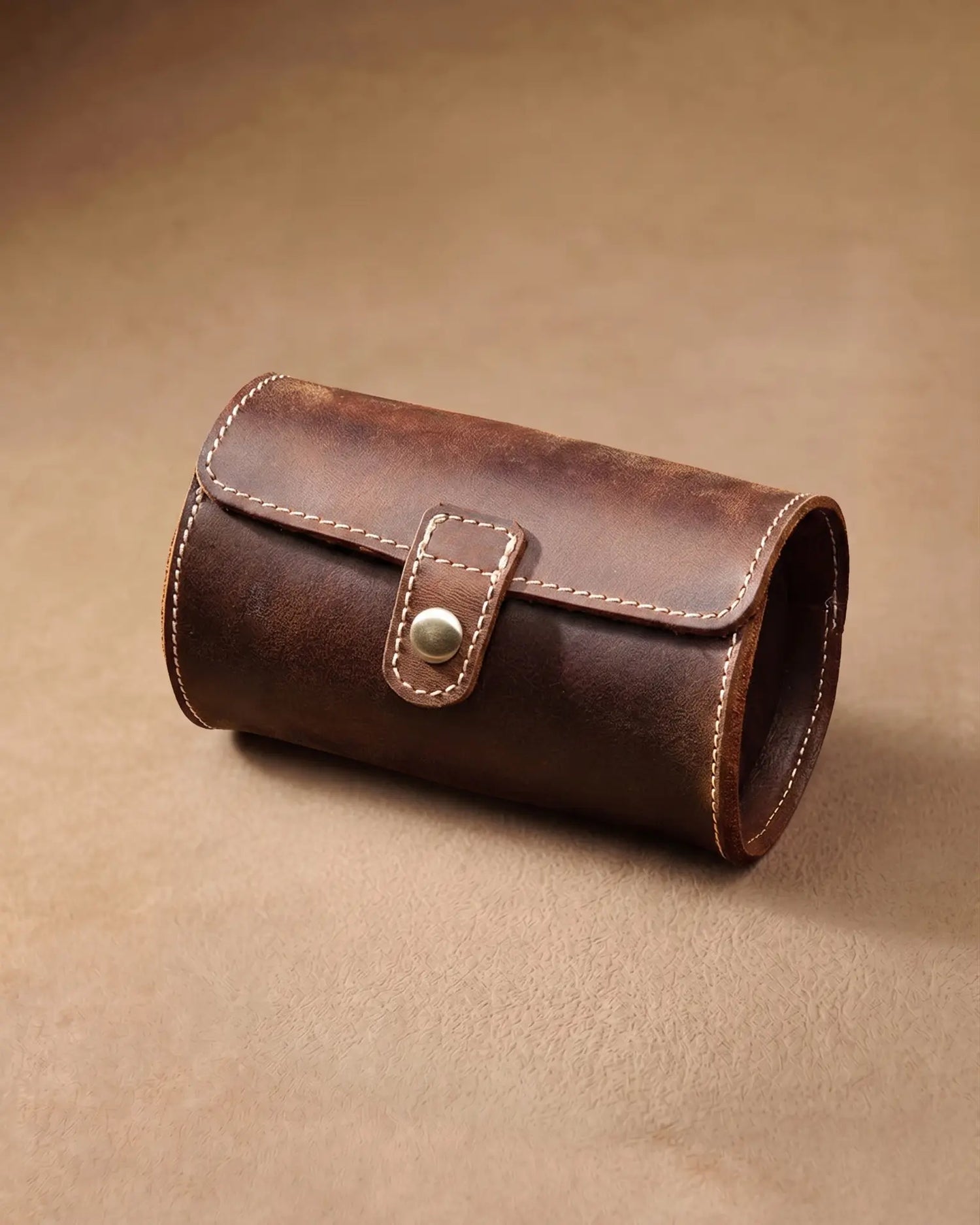
Journey Wrap Double Watch Roll
Regular price
$49.90 USD
Regular price
More Leather Guides
Explore practical guides to choosing, using and caring for leather goods.

Custom Leather Bookmark Guide: Thickness, Engraving and Magnet Options

Magnetic Bookmark With Pen Holder: Who It Is For and How to Use It
